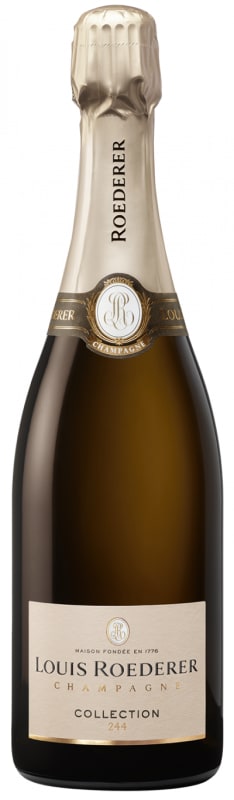


Winemaker Notes
Lovely golden yellow, very champagne-like, hue. Dense and steady flow of extremely fine bubbles. Deep, broad bouquet of ripe fruit (wild peaches, William pears) combined with citrus (lemons, blood oranges). The iodized and smoky notes, associated with the autolysis and the ageing in wood, add aromatic freshness. Then come notes of chalk and a hint of reduction, suggesting that the wine will be concentrated and powerful. The entry to the palate is delicious showing a rich and robust texture. There is a very juicy and concentrated sensation as if you were biting into a ripe fruit. The substance is caressingly soft, coating the palate but is then immediately lightened by the delicate bubbles. The length is created by a lovely backbone of chalky freshness. The wine is both delectably rich, with a slightly roasted character, and super fresh thanks to a salivating finish. The smoky notes then take over to underpin a very flavorsome finish.
Collection 244 marks the return of the texture of the Meunier from the Marne and the Montagne, which adds a lovely richness to the well-structured and saline Pinot Noir and Chardonnay grapes.
Blend: 41% Chardonnay, 33% Pinot Noir, 26% Meunier
Professional Ratings
-
James Suckling
The first impression is as invigorating as a sea breeze. I love the interplay of mirabelle, grapefruit and lychee fruit with minty freshness and waxiness from lees contact. And all this is welded to a beautifully proportioned palate with plenty of structure, the acidity bright and the mousse animating. Very salty finish that pulls you back for more. A cuvee of 41% chardonnay, 33% pinot noir and 26% pinot meunier. Of these, 15% fermented in oak and 85% in stainless steel. The final blend contained 36% reserve perpetual and 10% reserve wines of the 2012 - 2018 vintage from oak. The dosage is 7 g/l.
-
Jeb Dunnuck
A pale silver/straw hue, the NV Champagne Collection 244 has 2019 as its base, with 42% Chardonnay, 26% Meunier, and the rest Pinot Noir. Expressive on opening, it’s fresh with a beautiful floral perfume and reveals pure notes of red berries, cherry, fresh peach, and a lovely fresh bit of primary fruit. It has a fine and refined mousse, and the palate is supple and inviting. Medium-bodied and elegant, with a ripe core, it has a delicate salinity to balance its freshness and has an attractive, lightly tannic feel while retaining a refined and precise profile. Approachable and fantastic now, it will be exciting to see how this develops over time. It continues to be an exceptional value.
-
Wine Enthusiast
The latest iteration of Roederer’s non vintage collection, this is tense with a fine aging character. It has richness and great fruit, a fine line of structure at the end.
-
Wine Spectator
An elegant Champagne, with bright acidity buoying a well-integrated range of ripe pear and white cherry, almond skin, fleur de sel and apple blossom notes. Fine and seamless, with a lingering, spiced finish.





Uncompromising Quality
Champagne Louis Roederer was founded in 1776 in Reims, France and is one of the rare family owned companies, which is still managed by the Roederer family. In 1833, Louis Roederer inherited the company from his uncle and renamed the company under his namesake. Under his leadership, the company rapidly grew while remaining true to their philosophy of uncompromising quality. Today, the company is under the helm of Jean-Claude Rouzaud and his son Frédéric who continue to place quality before quantity.
First-Rate Vineyards
Champagne Louis Roederer is one of the only French champagne producers to own nearly 75 percent of the grapes in the most desirable vineyards in the Champagne. The property is located on 450 acres in the finest villages of Montagne de Reims, Côtes des Blancs, and Valleé de la Marne. Each region is selected to produce Chardonnay and Pinot Noir with the elegance needed for perfectly balanced champagne. The Louis Roederer vineyards rate an average 98 percent based on France’s statutory 100-point classification scale.
The reserve wine is then tasted and graded by a team of Roederer specialists. They choose as many as 40 different wines from several lots for the blend. For the final touch, the wine is then added in order to enhance the cuvee and guarantee consistency while retaining the champagne's characteristics.

A term typically reserved for Champagne and Sparkling Wines, non-vintage or simply “NV” on a label indicates a blend of finished wines from different vintages (years of harvest). To make non-vintage Champagne, typically the current year’s harvest (in other words, the current vintage) forms the base of the blend. Finished wines from previous years, called “vins de reserve” are blended in at approximately 10-50% of the total volume in order to achieve the flavor, complexity, body and acidity for the desired house style. A tiny proportion of Champagnes are made from a single vintage.
There are also some very large production still wines that may not claim one particular vintage. This would be at the discretion of the winemaker’s goals for character of the final wine.

Associated with luxury, celebration, and romance, the region, Champagne, is home to the world’s most prized sparkling wine. In order to bear the label, ‘Champagne’, a sparkling wine must originate from this northeastern region of France—called Champagne—and adhere to strict quality standards. Made up of the three towns Reims, Épernay, and Aÿ, it was here that the traditional method of sparkling wine production was both invented and perfected, birthing a winemaking technique as well as a flavor profile that is now emulated worldwide.
Well-drained, limestone and chalky soil defines much of the region, which lend a mineral component to its wines. Champagne’s cold, continental climate promotes ample acidity in its grapes but weather differences from year to year can create significant variation between vintages. While vintage Champagnes are produced in exceptional years, non-vintage cuvées are produced annually from a blend of several years in order to produce Champagnes that maintain a consistent house style.
With nearly negligible exceptions, . These can be blended together or bottled as individual varietal Champagnes, depending on the final style of wine desired. Chardonnay, the only white variety, contributes freshness, elegance, lively acidity and notes of citrus, orchard fruit and white flowers. Pinot Noir and its relative Pinot Meunier, provide the backbone to many blends, adding structure, body and supple red fruit flavors. Wines with a large proportion of Pinot Meunier will be ready to drink earlier, while Pinot Noir contributes to longevity. Whether it is white or rosé, most Champagne is made from a blend of red and white grapes—and uniquely, rosé is often produce by blending together red and white wine. A Champagne made exclusively from Chardonnay will be labeled as ‘blanc de blancs,’ while ones comprised of only red grapes are called ‘blanc de noirs.’