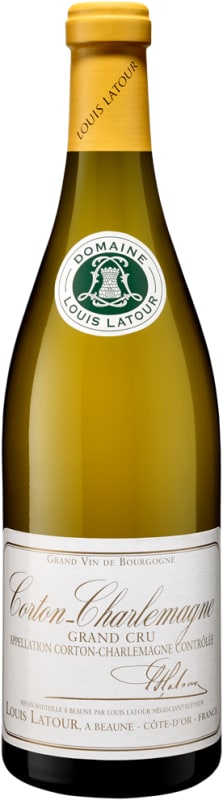


Winemaker Notes
With a superb pale yellow color, the Corton-Charlemagne Grand Cru 2014 shows an intense and complex nose of grilled almond with lightly smoked notes. Aromas of almond paste blends with flinty notes. The mouth is powerful, generous and frank. We also find grilled notes and fresh almond aromas. Very beautiful length, with nice minerality.
Professional Ratings
-
Wine Spectator
A broad, charming white, featuring lemon, baked apple, vanilla, clove and nutmeg flavors, with fine concentration and length. Shows a bright structure and chalky intensity on the slightly tannic finish. Best from 2019 through 2032.
-
James Suckling
A dense and solid Corton-Charlemagne with hot-stone and dried-apple character. Some pears, too. Full-bodied, dense and polished. Shows layers and strength. Drink now.
-
Wine Enthusiast
Intense and concentrated, this offers ripe yellow fruits, rich apples and a tight mineral texture. It has power, reinforced by subtle wood aging. A flagship for this producer, the wine will age well. Drink from 2020. Cellar Selection.



Maison Louis Latour is one of the most highly-respected négociant-éléveurs in Burgundy. Maison Louis Latour is the producer of some of the finest Burgundian wines but has also pioneered the production of fine wines from outside Burgundy's confines. These wines from the Ardèche and the Côteaux de Verdon are slowly gaining esteem for their unmatchable quality outside Burgundy.
All the grapes from the vineyards owned by the Latour family are vinified and aged in the attractive cuverie of Chateau Corton Grancey in Aloxe-Corton. The winery was the first purpose-built cuverie in France and remains the oldest still functioning. A unique railway system with elevators allows the entire wine-making process to be achieved by the use of gravity. This eliminates the threat of oxidation from unnecessary pumping of the must. Since 1985, Louis Latour has been selling the wines of its own vineyards under the name Domaine Louis Latour.
Louis Latour has been a leader in environmentally responsible winemaking for over 15 years. Louis Latour has had ISO 14001 accreditation for Environmental Management Systems since 2003 and has been part of the European association FARRE since 1998- a group of like-minded companies who seek to develop and promote sustainable methods of agriculture.

One of the most popular and versatile white wine grapes, Chardonnay offers a wide range of flavors and styles depending on where it is grown and how it is made. While it tends to flourish in most environments, Chardonnay from its Burgundian homeland produces some of the most remarkable and longest lived examples. California produces both oaky, buttery styles and leaner, European-inspired wines. Somm Secret—The Burgundian subregion of Chablis, while typically using older oak barrels, produces a bright style similar to the unoaked style. Anyone who doesn't like oaky Chardonnay would likely enjoy Chablis.

The origin of perhaps the world’s very finest Pinot Noir, Côte de Nuits is the northern half of the Côte d'Or and includes the famous wine villages of Gevrey-Chambertin, Morey-St-Denis, Chambolle-Musigny, Vougeot, Vosne-Romanée, Flagey-Echezeaux and Nuits-St-Georges.
Fine whites from Chardonnay are certainly found in the Côte de Nuits, but with much less frequency than top-performing reds made of Pinot noir. The little village of Nuits-St-Georges in its southern end gave the region its name: Côte de Nuits. The city of Dijon marks its northern border.