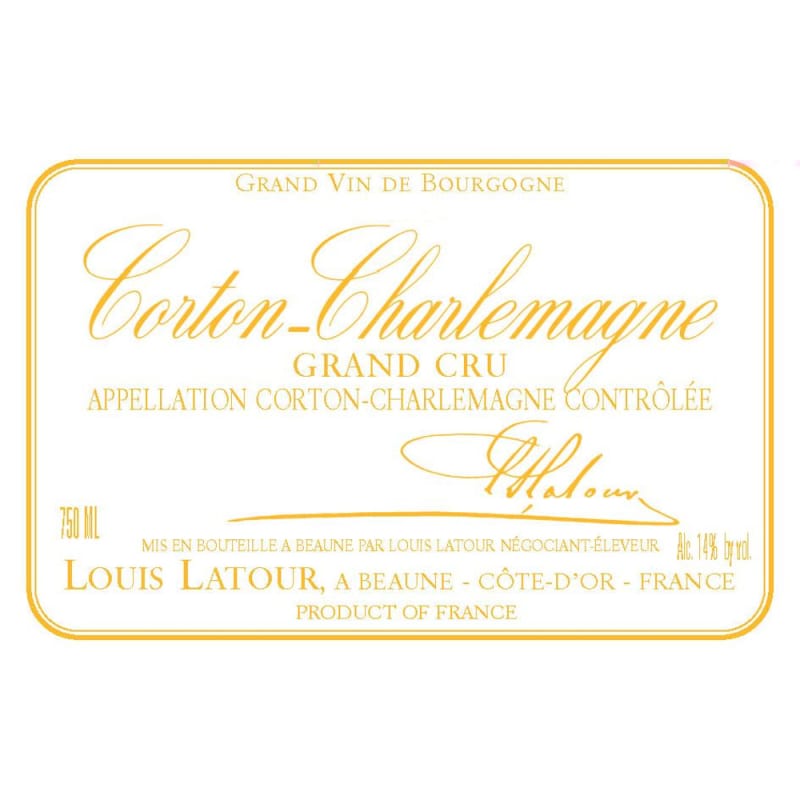

Winemaker Notes
After the ravages of the phylloxera aphid at the end of the 19th century it was the Latour family that took the now-celebrated decision to tear up the dead Aligoté and Pinot Noir vines and to replace them with Chardonnay. The vineyard of Corton-Charlemagne is situated in the prime area of the hillside of Corton where its southeasterly aspect ensures maximum exposure to the sun. The fruit is harvested as late as possible to guarantee maximum ripeness. This Grand Cru wine has a citrus bouquet with a rich tropical fruit character. It is intensely powerful and fills the mouth with a multiplicity of flavours ending in a fine, steely finish which lingers on the palate for minutes. This wine needs 4 to 5 years to open up and can age for up to 20 years.
Professional Ratings



Maison Louis Latour is one of the most highly-respected négociant-éléveurs in Burgundy. Maison Louis Latour is the producer of some of the finest Burgundian wines but has also pioneered the production of fine wines from outside Burgundy's confines. These wines from the Ardèche and the Côteaux de Verdon are slowly gaining esteem for their unmatchable quality outside Burgundy.
All the grapes from the vineyards owned by the Latour family are vinified and aged in the attractive cuverie of Chateau Corton Grancey in Aloxe-Corton. The winery was the first purpose-built cuverie in France and remains the oldest still functioning. A unique railway system with elevators allows the entire wine-making process to be achieved by the use of gravity. This eliminates the threat of oxidation from unnecessary pumping of the must. Since 1985, Louis Latour has been selling the wines of its own vineyards under the name Domaine Louis Latour.
Louis Latour has been a leader in environmentally responsible winemaking for over 15 years. Louis Latour has had ISO 14001 accreditation for Environmental Management Systems since 2003 and has been part of the European association FARRE since 1998- a group of like-minded companies who seek to develop and promote sustainable methods of agriculture.

One of the most popular and versatile white wine grapes, Chardonnay offers a wide range of flavors and styles depending on where it is grown and how it is made. While it tends to flourish in most environments, Chardonnay from its Burgundian homeland produces some of the most remarkable and longest lived examples. California produces both oaky, buttery styles and leaner, European-inspired wines. Somm Secret—The Burgundian subregion of Chablis, while typically using older oak barrels, produces a bright style similar to the unoaked style. Anyone who doesn't like oaky Chardonnay would likely enjoy Chablis.

A classic source of exceptional Chardonnay as well as Pinot Noir, the Côte de Beaune makes up the southern half of the Côte d’Or. Its principal wine-producing villages are Pernand-Vergelesses, Aloxe-Corton, Beaune, Pommard, Volnay, Meursault, Puligny-Montrachet and Chassagne-Montrachet.
The area is named for its own important town of Beaune, which is essentially the center of the Burgundy wine business and where many negociants center their work. Hospices de Beaune, the annual wine auction, is based here as well.