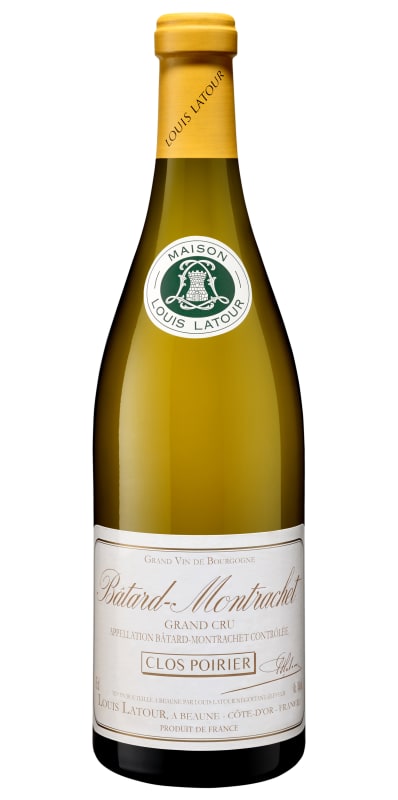


Winemaker Notes
Of a gold nuances color, this Bâtard-Montrachet "Clos Poirier" 2019 unveils an intense nose with yellow peach, almond paste and honey aromas. The mouth is ample and round with fresh almond, vanilla and brioche notes. This wine offers a beautiful tension as well as a slightly salty finish. Nice aromatic persistence.
Professional Ratings
-
James Suckling
Weight and vitality, concentration and elegance make this a very impressive white Burgundy, even though it is still pretty young. Time will undoubtedly amplify all this,because the wine already expands as it powers inexorably across the palate. Huge yet fresh finish. Drinkable now, but best from 2023.
-
Wine Spectator
Rich, with toasty oak and vanilla notes wrapped around peach, citronella, lemon tart and mineral flavors. Tightly wound as this builds to the finish, showing fine potential. Excellent intensity and length. Best from 2024 through 2033. 225 cases made, 100 cases imported.



Maison Louis Latour is one of the most highly-respected négociant-éléveurs in Burgundy. Maison Louis Latour is the producer of some of the finest Burgundian wines but has also pioneered the production of fine wines from outside Burgundy's confines. These wines from the Ardèche and the Côteaux de Verdon are slowly gaining esteem for their unmatchable quality outside Burgundy.
All the grapes from the vineyards owned by the Latour family are vinified and aged in the attractive cuverie of Chateau Corton Grancey in Aloxe-Corton. The winery was the first purpose-built cuverie in France and remains the oldest still functioning. A unique railway system with elevators allows the entire wine-making process to be achieved by the use of gravity. This eliminates the threat of oxidation from unnecessary pumping of the must. Since 1985, Louis Latour has been selling the wines of its own vineyards under the name Domaine Louis Latour.
Louis Latour has been a leader in environmentally responsible winemaking for over 15 years. Louis Latour has had ISO 14001 accreditation for Environmental Management Systems since 2003 and has been part of the European association FARRE since 1998- a group of like-minded companies who seek to develop and promote sustainable methods of agriculture.

One of the most popular and versatile white wine grapes, Chardonnay offers a wide range of flavors and styles depending on where it is grown and how it is made. While it tends to flourish in most environments, Chardonnay from its Burgundian homeland produces some of the most remarkable and longest lived examples. California produces both oaky, buttery styles and leaner, European-inspired wines. Somm Secret—The Burgundian subregion of Chablis, while typically using older oak barrels, produces a bright style similar to the unoaked style. Anyone who doesn't like oaky Chardonnay would likely enjoy Chablis.

A source of some of the finest, juicy, silky and elegantly floral Chardonnay in the Côte de Beaune, Puligny-Montrachet lies just to the north of Chassagne-Montrachet, a village with which it shares two of its Grands Crus vineyards: Le Montrachet itself and Bâtard-Montrachet. Its other two, which it owns in their entirety, are Chevalier-Montrachet and Bienvenues-Bâtard-Montrachet. And still, some of the finest white Burgundy wines come from the prized Premiers Crus vineyards of Puligny-Montrachet. To name a few, Les Pucelles, Le Clavoillon, Les Perrières, Les Referts and Les Combettes, as well as the rest, lie northeast and up slope from the Grands Crus.
Farther to the southeast are village level whites and the hamlet of Blagny where Pinot Noir grows best and has achieved Premier Cru status.