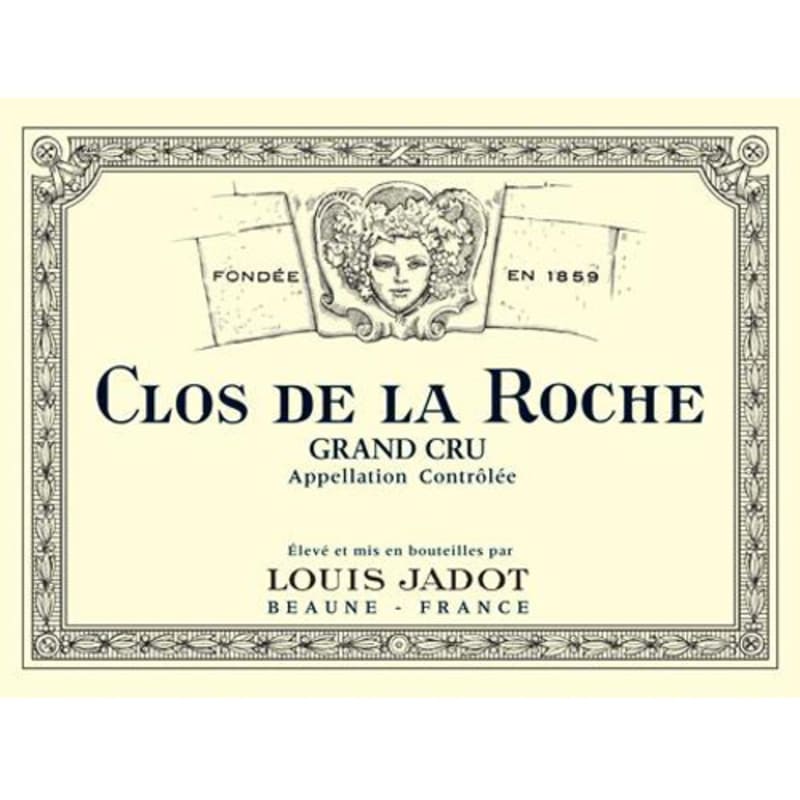

Winemaker Notes
Pairs well with meats in red wine sauce, game and medium cheeses.
Professional Ratings
-
Robert Parker's Wine Advocate
The 2012 Clos de la Roche Grand Cru has a primal bouquet that opens up with encouragement, but only slightly, with mulberry and raspberry fruit, touches of briary and damp moss. The palate is underpinned by very fine tannins. This is a feminine, harmonious and sensual Clos de la Roche prioritising elegance over power. There is a long tail on the finish that is velvety smooth and caressing. This is very seductive and classy.
One statement nonchalantly uttered by head winemaker Frederic Barnier not only summed up the 2012 vintage, but the plight of Burgundy in recent years. “We have lost around one and a half crops out of the last four.” Imagine losing your equivalent income? For a significant negociant such as Louis Jadot, one that under outgoing(ish) winemaker Jacques Lardiere and his successor, have constantly striven for quality, that dearth of fruit has a major impact. The dramatic decrease in crop means that more people are “fighting” for top quality contracted fruit. The rise in land prices has exacerbated the problem as few can afford to buy vineyards and therefore resort to building small negociant businesses and join the queue. Now, small operations that just require one flagship barrel of grand cru might just be able to afford to pay over the odds. However, a merchant such as Jadot simply cannot afford to do that when they need dozens of barrels to satisfy worldwide demand. So how do they do it? “Relationships,” answers Frederic, “It all comes down to relationships with our contracted growers.” For evidence of that, just flick down to my review of their Bienvenue-Batard-Montrachet that came a whisker away from never being made. So with all the sturm und drang, how are Louis Jadot faring? Suffice to say that Frederic seems to have slipped into Jacques Lardiere’s impossible-to-fill shoes by simply slipping into his own. There was a confidence about him when I conducted two morning sessions with him, though he never crosses the line into braggadocio. The first tasting focused on a complete horizontal of the white. “The (white) 2012s were very rich,” he remarked. “Some of the village crus were overwhelmed and they were too fat and heavy. So in order to maintain freshness we blocked the malo-lactic through sulfur addition.” Frederic goes into more detail of the vintage in the accompanying video, but the main point is that the skins were thick and the berries yielded very little juice. This meant that he had to exact a very prudent vinification in order to eke out the free-run juice without leeching hard, bitter, perhaps astringent elements. He appears to have done exactly that. While I would not say that it was an unmitigated success, after all when you annually produce 100 crus there are bound to be some that don’t quite make the grade, Louis Jadot’s 2012s continue a fine run of form that disprove the theory that large-scale merchants cannot produce wine equal if not better than bijou growers. And that comes from a lot of sweat and tears. Frederic rued that he had not seen his wife or children over the previous four weeks during the harvest! But these prenatal wines appear to have made that temporary estrangement worthwhile. These samples were all taken from barrel and prepared by Frederic Barnier on the same morning of my arrival, with as much effort to reflect the final blend as possible. Note that for the village crus, samples did not include deselected premier crus barrels that will obviously ameliorate those wines.
Range: 92-94 -
Wine Spectator
An opulent, powerful red, featuring cherry, strawberry, oak spice and earth aromas and flavors. Concentrated and chewy in texture, with all the elements in the right proportions. The finish is mouthwatering and leaves a minerally impression. Best from 2019 through 233.


Celebrated as some of the best wine in the universe, red wine from Burgundy, otherwise known as red Burgundy, is Pinot noir. In fact Burgundy is the birthplace of Pinot noir and the source of the planet’s most sensual, delicate, valuable and sought-after Pinot noir wines.
Understanding and enjoying red Burgundy can stay simple, with a basic knowledge of its subregions, become more intricate by dialing down to the villages and vineyards or become a life-long passion, exploring climats (plots of vines), vintages and the post French Revolution land ownership laws. In any case, a fine red Burgundy will display refined nuances of black currant, red fruit, earth, spice, alluring floral aromatics and have great elegance, complexity and longevity.
Most famous, praised and collected of Burgunday are those from the Côte d'Or. Hundreds of millions of years ago, the area now called Côte d'Or was under a warm ocean whose sea floor has, over time, shifted and decomposed into various layers of limestone, sandstone and clay interspersed with ancient fossilized sea creatures. This is what is referred to as the famous escarpment upon which all of the highly sought-after Grands Crus and Premiers Crus vineyards can be found. In other words, from north to south, the best vineyards of Gevrey-Chambertin, Morey-St-Denis, Chambolle-Musigny, Vougeot, Vosne-Romanée, Flagey-Echezeaux, Nuits-St-Georges, Aloxe-Corton, Pommard and Volnay follow the path of this ancient sea bed.