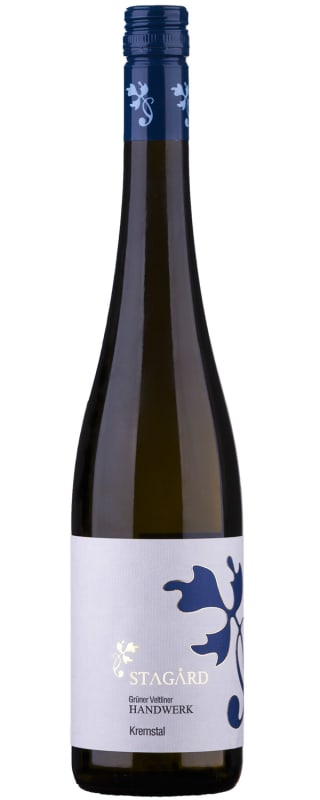


Winemaker Notes
This Grüner Veltliner is sourced from a selection of south-facing, mountain, and terrace vineyards all in the Pfaffenberg, but specifically from two lieux-dits called Danzern and Pitschental. The grapes were crushed and macerated for 24 hours before spontaneously fermenting in stainless steel, and 10% in neutral oak, where it remains on the lees and 2% whole berries for 8-10 months.
Professional Ratings
-
Vinous
The 2022 Grüner Veltliner Handwerk was harvested in Kremstal sites, from gneiss and conglomerate soils with a smaller proportion of loess and loam. The nose is a full hit of yeasty earthiness, pepper and super-savory miso paste, with hints of fern and sage. Peppery verve is alive on the palate, despite being bedded in this richness on a nonetheless slender body with a lovely phenolic web. (Bone-dry)


Fun to say and delightfully easy to drink, Grüner Veltliner calls Austria its homeland. While some easily quaffable Grüners come in a one-liter—a convenient size—many high caliber single vineyard bottlings can benefit from cellar aging. Somm Secret—About 75% of the world’s Grüner Veltliner comes from Austria but the variety is gaining ground in other countries, namely Hungary, the Czech Republic, Slovakia and the United States.

The region of considerable geologic diversity and microclimates, Kremstal extends virtually without border east from Wachau along the Danube River. Its magnificent terraced and rocky vineyards in the west alongside Wachau include some of Austria’s most esteemed Riesling vineyards, the (Steiner) Hund and Pfaffenberg, as well as Kögl and Wachtberg nearer to the city of Krems. After Krems, the vineyards become excessively steep upstream around Senftenberg where Riesling and Grüner Veltliner thrive. Grüner Veltliner does best from here east where the soils become a mix of sand, gravel and loess.
Grüner Veltliner and Riesling together comprise two thirds of all of the Kremstal vineyards; the region itself represents about five percent of Austria’s total vineyard area.