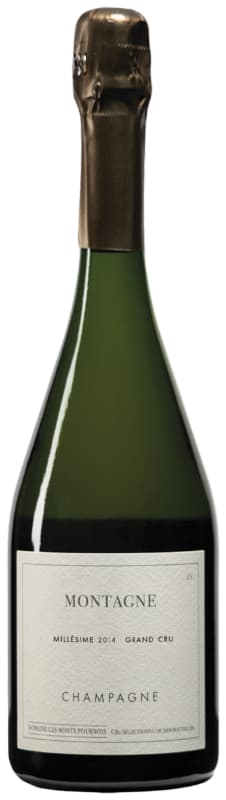


Winemaker Notes
Smooth, creamy, and golden, the nose of this 2014 vintage is full-bodied. Its rich fruitiness reveals full maturity. The fine, discreet effervescence transports us to a realm of elegance and refinement. Notes of flint mark the origin of this historic Verzy terroir. The long finish, both saline and chalky, confirms the exceptional terroir and quality of this Verzy 2014.
Blend: 50% Chardonnay, 50% Pinot Noir
Professional Ratings
-
Jeb Dunnuck
A bright silver/yellow color, the 2013 Champagne Grand Cru Verzy Montagne is part of an exploration of three expressions of 2013 from three terroirs. A 50/50 blend of Chardonnay and Pinot Noir, this was the coldest vintage for the Champagne harvest, beginning in early October – one of the only times this has happened since the 1990s. From Verzy, with its northeast exposition, it’s a cold wine, and referred to as timid, though I would say the point where Pinot Noir and Chardonnay meet is seamless. It offers the pretty lemon curd citrus of Chardonnay alongside the strawberry and delicate red fruit of Pinot. The elegance is superbly balanced and has real finesse. The cooling effect is gorgeous, and although it has undergone long maturation and aging, it already tastes fantastic now. Sweet pastry notes are present but not overly sweet. It’s also the most enticing of the trio. Drink 2026-2056.
-
Vinous
The 2014 Montagne Grand Cru (Verzy) is another stellar wine in this range from Domaine Les Monts Fournois. Citrus peel, slate, crushed rocks, mint, white pepper and chalk all race across the palate. The 2014 exudes Verzy coolness and mineral-drenched intensity. I Ioved it. Dosage is 2.3 grams per liter. Disgorged: November 2024.
-
Wine Spectator
This is a firm and tightly meshed version. With its chalky mousse, this leans toward austere in style at first but opens well in the glass, revealing a delicate weave of poached quince, cassis, tangerine peel and grilled macadamia nut flavors underscored by minerally oyster shell and saline notes. Shows a long, mouthwatering finish. Pinot Noir and Chardonnay. Disgorged November 2024. Drink now through 2040.


Representing the topmost expression of a Champagne house, a vintage Champagne is one made from the produce of a single, superior harvest year. Vintage Champagnes account for a mere 5% of total Champagne production and are produced about three times in a decade. Champagne is typically made as a blend of multiple years in order to preserve the house style; these will have non-vintage, or simply, NV on the label. The term, "vintage," as it applies to all wine, simply means a single harvest year.

Associated with luxury, celebration, and romance, the region, Champagne, is home to the world’s most prized sparkling wine. In order to bear the label, ‘Champagne’, a sparkling wine must originate from this northeastern region of France—called Champagne—and adhere to strict quality standards. Made up of the three towns Reims, Épernay, and Aÿ, it was here that the traditional method of sparkling wine production was both invented and perfected, birthing a winemaking technique as well as a flavor profile that is now emulated worldwide.
Well-drained, limestone and chalky soil defines much of the region, which lend a mineral component to its wines. Champagne’s cold, continental climate promotes ample acidity in its grapes but weather differences from year to year can create significant variation between vintages. While vintage Champagnes are produced in exceptional years, non-vintage cuvées are produced annually from a blend of several years in order to produce Champagnes that maintain a consistent house style.
With nearly negligible exceptions, . These can be blended together or bottled as individual varietal Champagnes, depending on the final style of wine desired. Chardonnay, the only white variety, contributes freshness, elegance, lively acidity and notes of citrus, orchard fruit and white flowers. Pinot Noir and its relative Pinot Meunier, provide the backbone to many blends, adding structure, body and supple red fruit flavors. Wines with a large proportion of Pinot Meunier will be ready to drink earlier, while Pinot Noir contributes to longevity. Whether it is white or rosé, most Champagne is made from a blend of red and white grapes—and uniquely, rosé is often produce by blending together red and white wine. A Champagne made exclusively from Chardonnay will be labeled as ‘blanc de blancs,’ while ones comprised of only red grapes are called ‘blanc de noirs.’