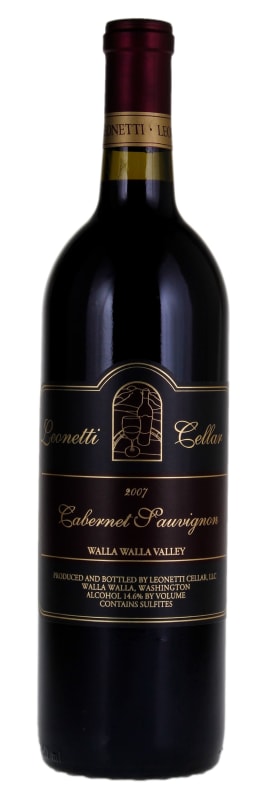


Winemaker Notes
Professional Ratings
-
Wine Enthusiast
The 76% Cabernet Sauvignon is melded with 17% Merlot, 4% Carmenère, and 3% Malbec, creating a stunningly dense, polished, tight wine. It’s light years away from the Leonetti’s of the 1980s—compact and loaded with black fruits, pepper, fresh herbs, rock, earth, toast and smoke. It’s so tight that it’s almost impossible to dissect. It needs time—a lot of time
-
Robert Parker's Wine Advocate
The 2007 Cabernet Sauvignon (76%) also contains 17% Merlot, 4% Carmenere, and 3% Malbec. It was aged for 22 months in a mix of new and used French oak. The nose displays herbs, olives, Asian spices, coffee/mocha, a hint of balsamic, black currant, and blackberry. This leads to a savory, intense, incipiently complex Cabernet that will benefit from 5-7 years of additional cellaring to show its full potential. It will be in its prime from 2015 to 2027.
-
Wine & Spirits
Like most of the Leonetti cabernets in the last few vintages, this is wound as tight as a drum at first pour. There's just a whiff of black cherry, a hint of tomato leaf and brown herbs. The flavors will need years to develop, but what's there is classic and deep, the juicy black fruit freshened by a touch of evergreen like a Blue Mountain breeze. For the cellar.
-
Wine Spectator
Firm in texture, with orange-scented red berry and red pepper flavors mingling effectively and persisting nicely against the tannins. This develops a sense of refinement on the long, medium-weight finish. Best from 2012 through 2017. 2,953 cases made.


A noble variety bestowed with both power and concentration, Cabernet Sauvignon enjoys success all over the globe, its best examples showing potential to age beautifully for decades. Cabernet Sauvignon flourishes in Bordeaux's Medoc where it is often blended with Merlot and smaller amounts of some combination of Cabernet Franc, Malbecand Petit Verdot. In the Napa Valley, ‘Cab’ is responsible for some of the world’s most prestigious, age-worthy and sought-after “cult” wines. Somm Secret—DNA profiling in 1997 revealed that Cabernet Sauvignon was born from a spontaneous crossing of Cabernet Franc and Sauvignon Blanc in 17th century southwest France.

Responsible for some of Washington’s most highly acclaimed wines, the Walla Walla Valley has experienced a surge in popularity in recent years and is home to both historic wineries and younger, up-and-coming producers.
The Walla Walla Valley, a Native American name meaning “many waters,” is located in southeastern Washington; part of the appellation actually extends into Oregon. Soils here are well-drained, sandy loess over Missoula Flood deposits and fractured basalt.
It is a region perfectly suited to Rhône-inspired Syrahs, distinguished by savory notes of red berry, black olive, smoke and fresh earth. Cabernet Sauvignon and Merlot create a range of styles from smooth and supple to robust and well-structured. White varieties are rare but some producers blend Sauvignon Blanc with Sémillon, resulting in a rich and round style, and plantings of Viognier, while minimal, are often quite successful.
Of note within Walla Walla, is one new and very peculiar appellation, called the Rocks District of Milton-Freewater. This is the only AVA in the U.S. whose boundaries are totally defined by the soil type. Soils here look a bit like those in the acclaimed Rhône region of Chateauneuf-du-Pape, but are large, ancient, basalt cobblestones. These stones work in the same way as they do in Chateauneuf, absorbing and then radiating the sun's heat up to enhance the ripening of grape clusters. The Rocks District is within the part of Walla Walla that spills over into Oregon and naturally excels in the production of Rhône varieties like Syrah, as well as the Bordeaux varieties.