
Winemaker Notes
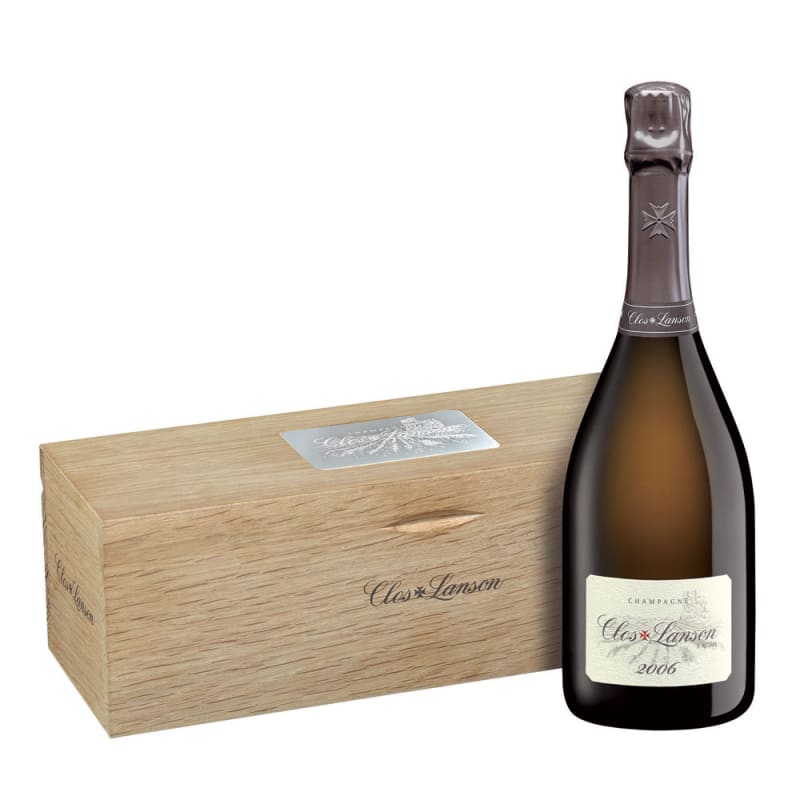
Wines from Clos Lanson have rare, unique characteristics that have always appealed to Lanson Wine-Makers. In 2006, the decision was made to oer connoisseurs the eponymous Cuvée from this promising vintage. Clos Lanson is a vintage Champagne whose juice, which comes exclusively from the rst pressing, is vinied for several months in oak barrels. After lengthy ageing in cellars, a precious wine is obtained: radiant, rich and extremely elegant. In 2016, Hervé Dantan decided to release the 7,870 bottles of Clos Lanson 2006. Each bottle is individually numbered and packaged in a beautiful wooden box.
Professional Ratings
-
Wine Enthusiast
This Champagne is produced from a small parcel of Chardonnay in the heart of the city of Reims above the Lanson cellars. It has more than rarity value with its wonderful mature flavors, richness and flavors of vanilla, baked apple and hints of the wood in which the wine fermented. It is ready to drink now.
-
Wine Spectator
A firm, focused version that expands on the palate, offering a layered mix of white cherry, acacia blossom, smoked almond and pastry cream, with a finely detailed mousse. The lasting finish echoes hints of orange liqueur, mineral and ground ginger. Disgorged December 2014. Drink now through 2026. 655 cases made.
-
Decanter
Generous fruit from the weathered chalk site is enhanced by a bright acidity, triggering mineral complexities. So delicious, tout en plaisir. The mineral imprint makes it a great match for ocean fish, especially turbot. A lovely surprise from the warm walled clos.
-
Robert Parker's Wine Advocate
From the immured one-hectare vineyard on the top of the hill, which also harbors the cellar of Champagne Lanson that dates back into the 18th century, the 2006 Clos Lanson is 100% first press Chardonnay from a very fine, chalky soil. It was fermented and aged in Argonne oak until spring 2007 (no malolactic fermentation), and disgorged after seven and a half years on the lees in December 2014 as Brut Nature with a dosage of three grams per liter. This bright yellow-golden colored prestige Champagne offers a brilliant nose of pure and ripe Chardonnay, along with delicate chalky flavors. Full and round on the palate, with a nice freshness and purity, this is a very elegant and well-balanced Blanc de Blancs. it has an aromatic as well as clear, fresh and mineral finish. This very first release has a very good length and characteristic mineral taste, with iodine notes along with ripe fruit and vanilla brioche flavors in the finish. This is a great new entry in the Lanson portfolio and it will improve with age.
Rating: 93+


Representing the topmost expression of a Champagne house, a vintage Champagne is one made from the produce of a single, superior harvest year. Vintage Champagnes account for a mere 5% of total Champagne production and are produced about three times in a decade. Champagne is typically made as a blend of multiple years in order to preserve the house style; these will have non-vintage, or simply, NV on the label. The term, "vintage," as it applies to all wine, simply means a single harvest year.

Associated with luxury, celebration, and romance, the region, Champagne, is home to the world’s most prized sparkling wine. In order to bear the label, ‘Champagne’, a sparkling wine must originate from this northeastern region of France—called Champagne—and adhere to strict quality standards. Made up of the three towns Reims, Épernay, and Aÿ, it was here that the traditional method of sparkling wine production was both invented and perfected, birthing a winemaking technique as well as a flavor profile that is now emulated worldwide.
Well-drained, limestone and chalky soil defines much of the region, which lend a mineral component to its wines. Champagne’s cold, continental climate promotes ample acidity in its grapes but weather differences from year to year can create significant variation between vintages. While vintage Champagnes are produced in exceptional years, non-vintage cuvées are produced annually from a blend of several years in order to produce Champagnes that maintain a consistent house style.
With nearly negligible exceptions, . These can be blended together or bottled as individual varietal Champagnes, depending on the final style of wine desired. Chardonnay, the only white variety, contributes freshness, elegance, lively acidity and notes of citrus, orchard fruit and white flowers. Pinot Noir and its relative Pinot Meunier, provide the backbone to many blends, adding structure, body and supple red fruit flavors. Wines with a large proportion of Pinot Meunier will be ready to drink earlier, while Pinot Noir contributes to longevity. Whether it is white or rosé, most Champagne is made from a blend of red and white grapes—and uniquely, rosé is often produce by blending together red and white wine. A Champagne made exclusively from Chardonnay will be labeled as ‘blanc de blancs,’ while ones comprised of only red grapes are called ‘blanc de noirs.’