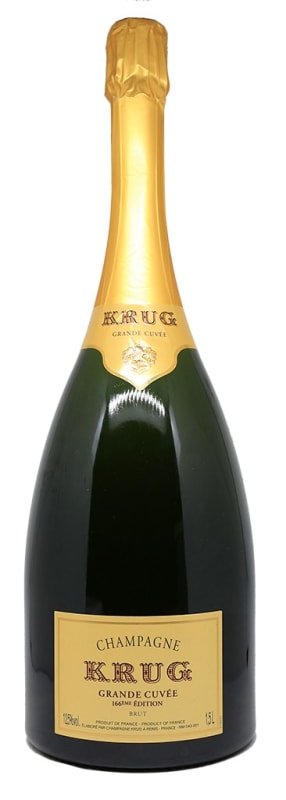


Winemaker Notes
Professional Ratings
-
Decanter
45% Pinot Noir, 39% Chardonnay, 16% Meunier, blended from 140 wines dating from 1996 to 2010, including 42% reserves. Krug leads off where most other Champagne houses end, and its entry wine is every bit a prestige cuvée. It smells and tastes like no other wine, a monumental paradox of tense freshness, profound maturity and inimitable complexity. Decadently rich, extravagantly complex and thunderingly expansive, Grande Cuvée is a vinous Champagne of multifaceted personality, yet ever-heightened tension. For all it represents, spanning 25 years of production, it presents incredible value. Drinking Window 2020 - 2030
-
James Suckling
A very complex nose here with ripe, deep lemon and grapefruit aromas on offer plus some restrained chalky elements, biscuit, some roasting herbs, hints of pepper, then a little tobacco too. Very complex and full of fresh characters. The palate has a wealth of different fruit flavors like lemon, peach, nectarine, and plums. The finesse in terms of structure, detail and precision is staggering; sherbet-like elegance with immense concentration and power. A great Grande Cuv‚e. Incredibly satisfying.
-
Robert Parker's Wine Advocate
Compared to Krug's 160th edition, the bright golden-yellow colored NV Grande Cuvée 166ème Édition (ID117010) is still a baby that shows the chalky and fruity features of a young white Burgundy intermixed with notes of Schwarzwälder Kirsch (dark cherries with black chocolate) and floral (ammonia) flavors on the pure, fresh and elegant yet intense and still yeasty brioche nose with its ripe apple aromas and refreshingly bright (lemon juice) overtones. Round, wide and very elegant yet also straight and tense on the palate, this 2010-dominated cuvée is very delicate, fresh and chalky but also dense and lush in its vinous texture. The finish is well-structured, fresh and persistent, indicating great complexity and vibrancy. However, I would wait at least another three years, during which time the 166th edition will gain even more finesse and quiet. The 166ème Édition is composed of 140 wines from 13 different harvests between 1998 and 2010, and it's a blend of 45% Pinot Noir with 39% Chardonnay and 15% Pinot Meunier, the latter of which provides the vivacity that the Chardonnay from the Côte des Blancs surprisingly didn't have in 2010, a vintage that was marked by its "tumultuous climate," as Eric Lebel writes. Tasted in New York in November 2018.
-
Wine Spectator
This mouthwatering Champagne feels like a swathe of raw silk on the palate, where flavors of sun-dried white cherry, toast and Meyer lemon peel are accented by expressive saffron, ground coffee and mandarin orange peel aromas. Long and racy on the honey-, spice- and smoke-laced finish. Disgorged winter 2017. Drink now through 2025.


A term typically reserved for Champagne and Sparkling Wines, non-vintage or simply “NV” on a label indicates a blend of finished wines from different vintages (years of harvest). To make non-vintage Champagne, typically the current year’s harvest (in other words, the current vintage) forms the base of the blend. Finished wines from previous years, called “vins de reserve” are blended in at approximately 10-50% of the total volume in order to achieve the flavor, complexity, body and acidity for the desired house style. A tiny proportion of Champagnes are made from a single vintage.
There are also some very large production still wines that may not claim one particular vintage. This would be at the discretion of the winemaker’s goals for character of the final wine.

Associated with luxury, celebration, and romance, the region, Champagne, is home to the world’s most prized sparkling wine. In order to bear the label, ‘Champagne’, a sparkling wine must originate from this northeastern region of France—called Champagne—and adhere to strict quality standards. Made up of the three towns Reims, Épernay, and Aÿ, it was here that the traditional method of sparkling wine production was both invented and perfected, birthing a winemaking technique as well as a flavor profile that is now emulated worldwide.
Well-drained, limestone and chalky soil defines much of the region, which lend a mineral component to its wines. Champagne’s cold, continental climate promotes ample acidity in its grapes but weather differences from year to year can create significant variation between vintages. While vintage Champagnes are produced in exceptional years, non-vintage cuvées are produced annually from a blend of several years in order to produce Champagnes that maintain a consistent house style.
With nearly negligible exceptions, . These can be blended together or bottled as individual varietal Champagnes, depending on the final style of wine desired. Chardonnay, the only white variety, contributes freshness, elegance, lively acidity and notes of citrus, orchard fruit and white flowers. Pinot Noir and its relative Pinot Meunier, provide the backbone to many blends, adding structure, body and supple red fruit flavors. Wines with a large proportion of Pinot Meunier will be ready to drink earlier, while Pinot Noir contributes to longevity. Whether it is white or rosé, most Champagne is made from a blend of red and white grapes—and uniquely, rosé is often produce by blending together red and white wine. A Champagne made exclusively from Chardonnay will be labeled as ‘blanc de blancs,’ while ones comprised of only red grapes are called ‘blanc de noirs.’