

Winemaker Notes
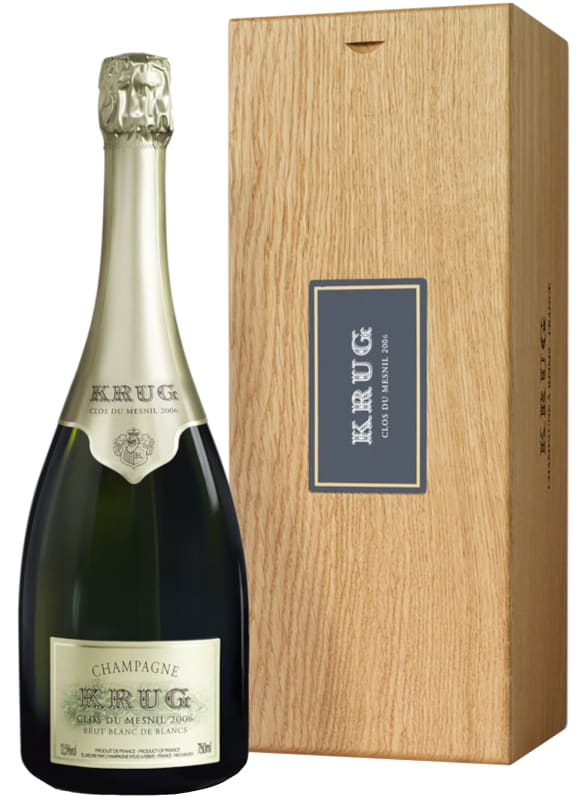
Krug Clos du Mesnil 2006 exalts the extreme purity of one of the finest terroirs in Champagne – a single walled plot of vines, the Clos du Mesnil – and of a single grape variety, Chardonnay - from a single year, 2006.
A chiseled and elegant expression of its terroir, Krug Clos du Mesnil 2006 is the 19th champagne from this unique plot, the first was created from the 1979 harvest.
At first sight, vibrant luminosity and an intense golden color redolent of ripe wheat.
On the nose, delicate aromas of citrus, barley sugar and dried fruits with balance and freshness. On the palate, it is generous and round with beautiful intensity. Initial hints of madeleine cake and brioche give way to notes of pastry, tarte tatin, lemon meringue, bitter orange and a little spice. The finish is long, with great tension and notes of candied ginger.
Professional Ratings
-
James Suckling
This is a fabulous edition of Clos du Mesnil. The pure chardonnay is magnificent with density and agility at the same time. Apple and mineral notes with cream and biscuit character. Citrus and hints of mirabelle. Chalky, yet stony at the same time. Layered, yet linear and really long. But remains subtle. The acidity is so precise and focuses the flavors and nature. Lasts for minutes. Even better than the 2004.
-
Decanter
This delicious, youthful wine opens with notes of ripe apple, hawthorn, and cream suffused with a bright minerality. The texture is hedonistically creamy and supple, yet there is backbone here as well and enough substance to last for decades. The Chardonnay for this superlative Blanc de Blancs was picked on 14-16 September before cask fermentation and ageing 12 years on the lees of the second fermentation. Disgorged with an extra-brut dosage in the summer of 2019.
-
Robert Parker's Wine Advocate
Slated for release later this year, Krug's 2006 Blanc de Blancs Clos du Mesnil unwinds in the glass with aromas of buttered citrus fruit, crisp green pear, warm pastry, freshly baked bread, apricot and licorice. Full-bodied, layered and concentrated, the 2006's comparatively extroverted and gourmand bouquet is in contrast to its deep, chiseled and tightly wound palate, and it's here that the site really dominates the vintage signature. Long, sapid and penetrating, complemented by a pillowy pinpoint mousse, this is a brilliant Blanc de Blancs that has been well worth the wait. By the standards of young Clos du Mesnil, it's already quite approachable and can already be drunk with considerable satisfaction.
-
Vinous
The 2006 Clos du Mesnil was harvested over three days, which is remarkable for a tiny parcel measuring 1.84 hectares divided into five blocks that are often picked over a wider timeframe. Soaring in the glass, the 2006 is stratospheric in its beauty. The richness of the year contrasts so beautifully with the flintiness and energy of Mesnil. With time in the glass the mousse softens, releasing layers of vinous intensity. Tangerine oil, pastry, lemon confit and marzipan all build effortlessly. The 2006 is sumptuous, racy and exotic to the core, with all of that richness supported by a phenolic, intense frame. This is Krug ID: 319030.
-
Wine Spectator
A stunner, displaying all the lithe grace of a ballet dancer that belies the underlying powerful musculature. Sleek acidity creates a mouthwatering impression throughout, seamlessly knit with the fine, creamy texture. Expressive lime blossom and spice aromatics are layered with fruit flavors of poached apricot, dried cherry and a touch of passion fruit coulis. Long and minerally on the racy finish, echoing rich, savory notes of grilled nut and espresso. Disgorged summer 2019. Drink now through 2036.


Representing the topmost expression of a Champagne house, a vintage Champagne is one made from the produce of a single, superior harvest year. Vintage Champagnes account for a mere 5% of total Champagne production and are produced about three times in a decade. Champagne is typically made as a blend of multiple years in order to preserve the house style; these will have non-vintage, or simply, NV on the label. The term, "vintage," as it applies to all wine, simply means a single harvest year.

Associated with luxury, celebration, and romance, the region, Champagne, is home to the world’s most prized sparkling wine. In order to bear the label, ‘Champagne’, a sparkling wine must originate from this northeastern region of France—called Champagne—and adhere to strict quality standards. Made up of the three towns Reims, Épernay, and Aÿ, it was here that the traditional method of sparkling wine production was both invented and perfected, birthing a winemaking technique as well as a flavor profile that is now emulated worldwide.
Well-drained, limestone and chalky soil defines much of the region, which lend a mineral component to its wines. Champagne’s cold, continental climate promotes ample acidity in its grapes but weather differences from year to year can create significant variation between vintages. While vintage Champagnes are produced in exceptional years, non-vintage cuvées are produced annually from a blend of several years in order to produce Champagnes that maintain a consistent house style.
With nearly negligible exceptions, . These can be blended together or bottled as individual varietal Champagnes, depending on the final style of wine desired. Chardonnay, the only white variety, contributes freshness, elegance, lively acidity and notes of citrus, orchard fruit and white flowers. Pinot Noir and its relative Pinot Meunier, provide the backbone to many blends, adding structure, body and supple red fruit flavors. Wines with a large proportion of Pinot Meunier will be ready to drink earlier, while Pinot Noir contributes to longevity. Whether it is white or rosé, most Champagne is made from a blend of red and white grapes—and uniquely, rosé is often produce by blending together red and white wine. A Champagne made exclusively from Chardonnay will be labeled as ‘blanc de blancs,’ while ones comprised of only red grapes are called ‘blanc de noirs.’