

Winemaker Notes
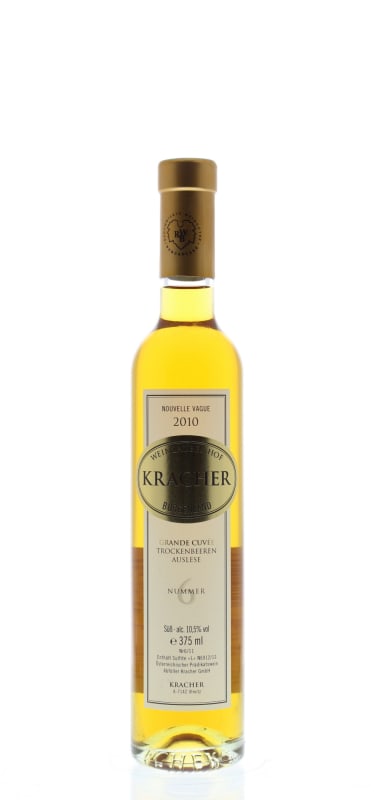
Blend: 60% Chardonnay, 40% Welschriesling
Professional Ratings
-
Robert Parker's Wine Advocate
60% Chardonnay and 40% Welschriesling make up for the bright amber-colored 2010 Grande Cuvée Trockenbeerenauslese No 6 Nouvelle Vague offers a deep and spicy rather than fruity, concentrated and very generous bouquet with chestnut and kumquat flavors. Concentrated, piquant, intense and really noble in its texture, this is a very elegant, firmly structured, long and more tannic TBA (compared to the Zwischen den Seen wines). This wine has a long, complex and aromatic finish. It is still sharp in its piquancy and needs some years to become more elegant and finesse-full. Quite powerful and fiery.
-
Wine Enthusiast
Kracher always produces a blend in his range of TBAs. This is a hugely rich wine that’s densely textured and with opulent fruit. Flavors of sweet oranges, honey and lemon juice makes up this impressively appealing wine. It does need to age, though, so drink from 2017.
-
Wine Spectator
Butter cream notes abound in this big and juicy sweetie, featuring ripe pear, apple and peach flavors, with some candied ginger notes. Viscous and spicy at midpalate, this delivers a long and custardy, yet crisp, finish that goes on and on. Welschriesling and Chardonnay. Drink now through 2045. 225 cases made.


Apart from the classics, we find many regional gems of different styles.
Late harvest wines are probably the easiest to understand. Grapes are picked so late that the sugars build up and residual sugar remains after the fermentation process. Ice wine, a style founded in Germany and there referred to as eiswein, is an extreme late harvest wine, produced from grapes frozen on the vine, and pressed while still frozen, resulting in a higher concentration of sugar. It is becoming a specialty of Canada as well, where it takes on the English name of ice wine.
Vin Santo, literally “holy wine,” is a Tuscan sweet wine made from drying the local white grapes Trebbiano Toscano and Malvasia in the winery and not pressing until somewhere between November and March.
Rutherglen is an historic wine region in northeast Victoria, Australia, famous for its fortified Topaque and Muscat with complex tawny characteristics.

The source of Austria’s finest botrytized sweet wines, Burgenland covers a lofty portion of Austria's wine producing real estate. It encompasses the smaller regions of Neusiedlersee, Neusiedlersee-Hügelland, Mittelburgenland and Südburgenland. The latter two are most associated with their exceptional red wines. The region as a whole produces no shortage of important whites.
Neusiedlersee, named for the lake that it surrounds to the east, is home to a great diversity of grape varieties. The region’s most notable wines, however, are the botrytis-infected, sweet versions.
Neusiedlersee-Hügelland, which wraps the lake on its western side, includes the town of Rust, a historically esteemed wine community. Its close proximity to the lake’s fog and mist make it another source of some of the more prestigious botrytized wines. Neusiedlersee-Hügelland also produces fine Blaufränkisch, Pinot Blanc, Neuburger and Grüner Veltliner, though a label will usually name the more general, Burgenland, so as not to confuse it with its eastern cousin, Neusiedlersee, across the lake.
Blaufränkisch is well suited to and makes up over half of the vineyard area in Mittelburgenland. The region’s hills and plateaus, which are composed of variations in schist, loess and clay-limestone, produce high quality reds with interesting diversity.
Südburgenland, also known for its deep, complex and age-worthy Blaufränkisch, is beginning to turn out some alluring whites from Grüner Veltliner, Welschriesling and Weissburgunder (Pinot Blanc).