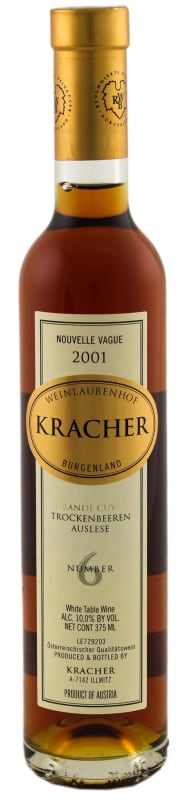


Winemaker Notes
Pair the Grande Cuvée Trockenbeerenauslese "Nouvelle Vague" No. 6 with tarte tatin, sliced pancakes served with plum compote and Époisses de Bourgogne.
Professional Ratings
-
Robert Parker's Wine Advocate
The amber-colored 2001 Grande Cuvée Trockenbeerenauslese No 6 Nouvelle Vague displays a beautifully matured, malty and pumpernickel bouquet with chestnuts and toasty flavors of dark caramel, dried apricots and walnuts. Very transparent, highly elegant and finesse-full on the palate, with a very salty and firmly structured finish, this is a fascinating sweet wine that has matured much quicker than other vintages. "2001 was a very warm, but also very late vintage because botrytis came very late," says Gerhard Kracher, who had 20-year-old vines then.
-
Wine Spectator
Terrific flavors of apricot, hazelnut, butter and vanilla pick up a smoky element on the finish. It's the seamless texture and lively structure that complete the overall impression. More elegant than some of the Kracher lineup, showing well now.


Apart from the classics, we find many regional gems of different styles.
Late harvest wines are probably the easiest to understand. Grapes are picked so late that the sugars build up and residual sugar remains after the fermentation process. Ice wine, a style founded in Germany and there referred to as eiswein, is an extreme late harvest wine, produced from grapes frozen on the vine, and pressed while still frozen, resulting in a higher concentration of sugar. It is becoming a specialty of Canada as well, where it takes on the English name of ice wine.
Vin Santo, literally “holy wine,” is a Tuscan sweet wine made from drying the local white grapes Trebbiano Toscano and Malvasia in the winery and not pressing until somewhere between November and March.
Rutherglen is an historic wine region in northeast Victoria, Australia, famous for its fortified Topaque and Muscat with complex tawny characteristics.

Appreciated for superior wines made from indigenous varieties, Austria should be on the radar of any curious wine drinker. A rather cool and dry wine growing region, this country produces wine that is quintessentially European in style: food-friendly with racy acidity, moderate alcohol and fresh fruit flavors.
Austria’s viticultural history is rich and vast, dating back to Celtic tribes with first written record of winemaking starting with the Romans. But the 20th century brought Austria a series of winemaking obstacles, namely the plunder of both world wars, as well as its own self-imposed quality breach. In the mid 1980s, after a handful of shameless vintners were found to have added diethylene glycol (a toxic substance) to their sweet wines to imitate the unctuous qualities imparted by botrytis, Austria’s credibility as a wine-producing country was compromised. While no one was harmed, the incident forced the country to rebound and recover stronger than ever. By the 1990s, Austria was back on the playing field with exports and today is prized globally for its quality standards and dedication to purity and excellence.
Grüner Veltliner, known for its racy acidity and herbal, peppery aromatics, is Austria's most important white variety, comprising nearly a third of Austrian plantings. Riesling in Austria is high in quality but not quantity, planted on less than 5% of the country’s vineyard land. Austrian Rieslings are almost always dry and are full of bright citrus flavors and good acidity. Red varietal wines include the tart and peppery Zweigelt, spicy and dense Blaufränkisch and juicy Saint Laurent. These red varieties are also sometimes blended.