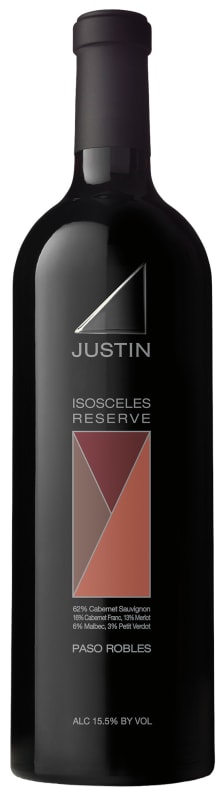


Winemaker Notes
Bright with a deeply concentrated purple/ruby core that extends nearly to the rim. Thick tears form slowly on the glass and leave substantial staining. Powerful and complex with notes of ripe black cherry, blackberry preserves, dried plum, and plump blueberry with herbal notes of sage, tarragon, fresh tobacco leaf, saddle leather, white pepper, toasted cinnamon, nutmeg, and oak. Full-bodied with intense flavors of black cherry, boysenberry, cassis, and elderberry on entry with notes of leather, dried herbs, clove, nutmeg, sweet tobacco, camphor, and rich velvety tannins appearing on the mid-palate. The finish is long featuring rich dark fruit and subtle notes of dried rose petal with toasted oak and lingering mouth-filling tannins.
Blend: The 2018 Isosceles is a bold wine with ripe fruit and attractive savory elements, which balance each other perfectly. This wine is rich and complex enough to be enjoyed on its own but is a perfect match with a classic filet mignon with traditional sides.
Blend: 62% Cabernet Sauvignon, 16% Cabernet Franc, 13% Merlot, 6% Malbec, 3% Petit Verdot
Professional Ratings
-
Vinous
Sour cherry combines with dark chocolate and dusty rose nuances as the 2018 Isosceles Reserve slowly opens in the glass. It's round and supple, impressing with its blend of ripe red and blue-toned fruits accentuated by lavender and sweet spice. While structured, a lingering twang of sour citrus and licorice adds captivating depth. Residual acids maintain a lovely freshness.
-
James Suckling
Attractive cabernet character here, with blackcurrants, wild berries, cedar, hazelnuts, tobacco and graphite. Some toasted cloves, too. Full-bodied, firm and nicely uniform, with fine, polished tannins. Balanced and sleek with a linear finish. A blend of 62% cabernet sauvignon, 16% cabernet franc, 13% merlot, 6% malbec and 3% petit verdot. Drink or hold.



The pioneer of Paso Robles, JUSTIN Vineyards & Winery was founded in 1981 by Justin Baldwin and is known for crafting world-class wines using Bordeaux grape varieties. Once the grapes are harvested, JUSTIN Winemaker Scott Shirley and his team sort, select, age, taste, blend, and decide what goes into every bottle. JUSTIN consistently receives top honors around the world, establishing itself as a leader in new-world Bordeaux-style winemaking. JUSTIN's Vineyard Estate features a Tasting Room, luxury five-star accommodations at the JUST INN, and a MICHELIN-starred Restaurant-making it one of the only wineries on the Central Coast to offer all three amenities. JUSTIN also has a downtown Paso Robles tasting room where guests can enjoy their wines. Visit to discover what makes JUSTIN Vineyards & Winery so exceptional.

One of the world’s most classic and popular styles of red wine, Bordeaux-inspired blends have spread from their homeland in France to nearly every corner of the New World. Typically based on either Cabernet Sauvignon or Merlot and supported by Cabernet Franc, Malbec and Petit Verdot, the best of these are densely hued, fragrant, full of fruit and boast a structure that begs for cellar time. Somm Secret—Blends from Bordeaux are generally earthier compared to those from the New World, which tend to be fruit-dominant.

Paso Robles has made a name for itself as a source of supple, powerful, fruit-driven Central Coast wines. But with eleven smaller sub-AVAs, there is actually quite a bit of diversity to be found in this inland portion of California’s Central Coast.
Just east over the Santa Lucia Mountains from the chilly Pacific Ocean, lie the coolest in the region: Adelaida, Templeton Gap and (Paso Robles) Willow Creek Districts, as well as York Mountain AVA and Santa Margarita Ranch. These all experience more ocean fog, wind and precipitation compared to the rest of the Paso sub-appellations. The San Miguel, (Paso Robles) Estrella, (Paso Robles) Geneso, (Paso Robles) Highlands, El Pomar and Creston Districts, along with San Juan Creek, are the hotter, more western appellations of the greater Paso Robles AVA.
This is mostly red wine country, with Cabernet Sauvignon and Zinfandel standing out as the star performers. Other popular varieties include Merlot, Petite Sirah, Petit Verdot, Syrah, Grenache and Rhône blends, both red and white. There is a fairly uniform tendency here towards wines that are unapologetically bold and opulently fruit-driven, albeit with a surprising amount of acidity thanks to the region’s chilly nighttime temperatures.