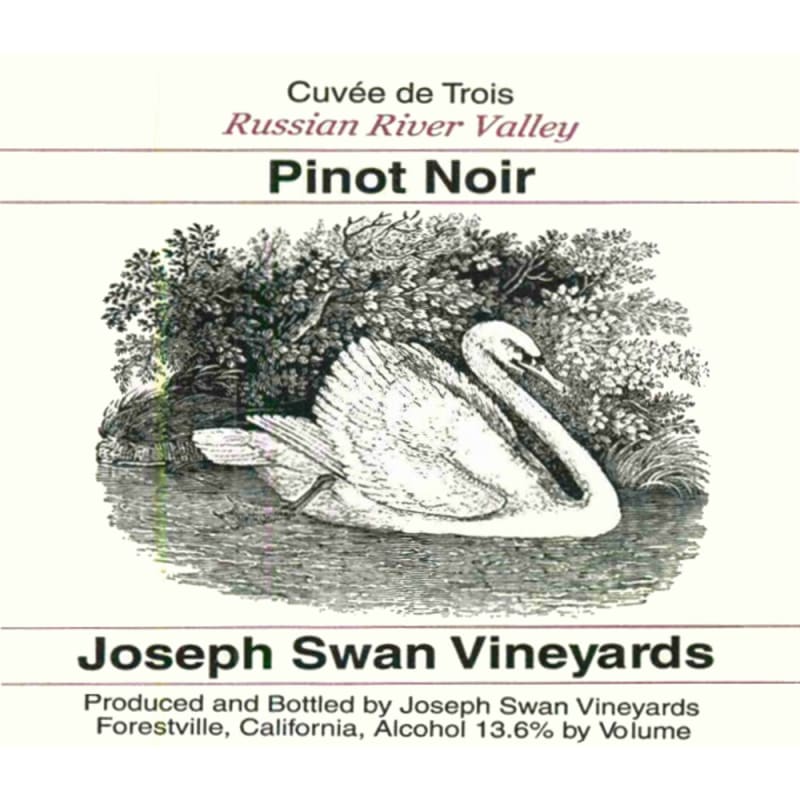
Joseph Swan Cuvee de Trois Pinot Noir 2013 Front Label

Winemaker Notes

Since its birth with the 1999 vintage, this has proved to be our most popular wine. It is poured in top restaurants across the country, in Canada, the UK and has even shown up on the lists of a top restaurant group In Australia. (I have no idea how it got to Australia). We produce more of it than any other wine we make, by far, but it never seems to be enough. The reason for its success is pretty simple. We make all of our pinot noirs with the same goal in mind: to be the best that they can be. Just before bottling we taste through all of the barrels, grade them and write tasting notes. The results are put into a spreadsheet (my writing is so miserable even I can’t read it most of the time) and then make decisions on what might be the best vineyard blends. However it is not just about quality. The vineyard wines must reflect the terroir (voice) of each site. Sometimes the best barrels have such a loud voice that they drown out the other elements. This often leaves a large number of barrels without a home. This becomes the theoretical base for the C3. After numerous blending trials a happy medium is usually reached. The best possible C3, which has to represent the Russian River Valley as a whole rather than the unique expressions of the more idiosyncratic vineyard wines. The vineyard wines should uniquely express their terroir. The C3 has more latitude. The one thing that they have in common is that that have to be the best that they can be. Nothing is made to go into the C3, thus the cost to produce it is no less than the vineyard wines.
Joseph Swan

Joseph Swan

View all products
Image for  content section
View all products
Image for Russian River Pinot Noir content section
View all products

While the Russian River Valley is a large appellation with multiple climate zones and soil types, it is best known for cool-climate varieties, with Pinot Noir as the most celebrated. The grapes benefit from a reliable late afternoon flow of Pacific Ocean fog through the Petaluma Gap and along the Russian River Valley that ensures slow and steady ripening and the preservation of grape acidity. Today many of California’s most highly regarded Pinot Noir vineyards are in the Russian River Valley, along with its sub-appellation, Green Valley.

Historically Russian River Valley Pinot Noirs had bright red fruit and delicate earthy, mineral notes. But changes in viticultural and winemaking practices have led to stylistic changes in some of the region’s wines. Adjustments to canopy management, among other techniques, have resulted in riper fruit and bolder wines as well. These show flavors of black cherry, blackberry, cola, spice and darker, loamy earth tones, accenting traditional Pinot Noir notes of strawberry, raspberry and light cherry.

SKRCJW079_2013 Item# 163307