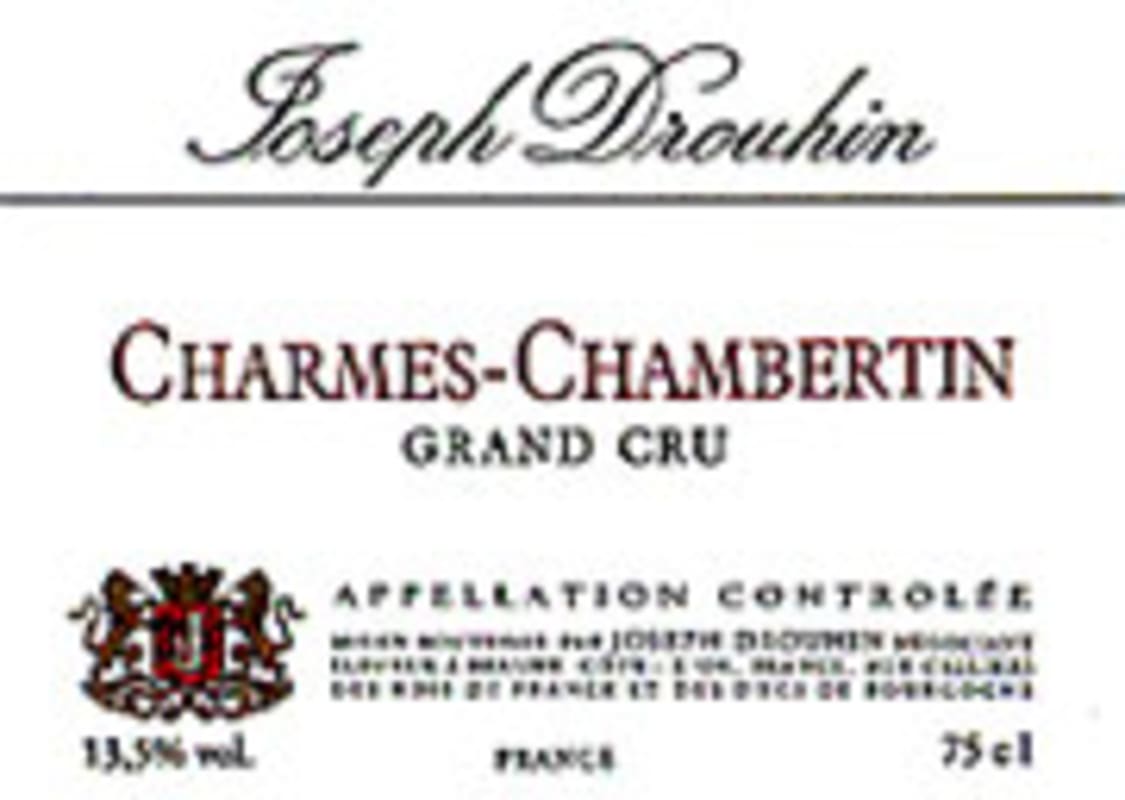

Winemaker Notes
Charmes-Chambertin lies directly below Le Chambertin with which it shares the same kind of small pebbles and brownish earth.
Charmes-Chambertin is of course entirely planted in Pinot Noir Fin, pruned very short according to the traditional "taille Guyot". No fertilizers or weed killers are used.
The grapes are always hand-picked and carefully brought to the Drouhin cellars in small crates. Joseph Drouhin's winemaking technique remains strictly traditional. Fermentation and maceration occur in wooden open vats with punching down of the cap and pumping over of the juice.
The wine is then put in oak barrels where it loses its acidity through the malolactic fermentation. It is left to age for about 18 months and is fined with egg-whites prior to bottling.
Charmes-Chambertin has a bright, ruby colour and a seductive nose where cherry and pit flavours dominate. After a few minutes of aeration, a more woody, even spicy, aroma comes out and seems to play a game of "hide and seek" with the fruit.
The flavours are all extraordinary in their richness : neither rough nor heavy, the architecture of the wine is a marvel of harmony, with very fine and noble tannins bringing a silky roundness to the wine. This is what people in Burgundy call the "gras". A more energetic note is added by the acidity. The impressions left on the palate are yet another chapter to this story : candied cherry, exotic barks, refined spices; according to some experts, this is where the real tasting begins ... and it goes on and on.
This is a grand wine which deserves the best accompaniment: prime meat, morels, truffles, wild hare, aged cheeses. Charmes-Chambertin is a rare and generous wine for the greatest occasions.
Professional Ratings


Celebrated as some of the best wine in the universe, red wine from Burgundy, otherwise known as red Burgundy, is Pinot noir. In fact Burgundy is the birthplace of Pinot noir and the source of the planet’s most sensual, delicate, valuable and sought-after Pinot noir wines.
Understanding and enjoying red Burgundy can stay simple, with a basic knowledge of its subregions, become more intricate by dialing down to the villages and vineyards or become a life-long passion, exploring climats (plots of vines), vintages and the post French Revolution land ownership laws. In any case, a fine red Burgundy will display refined nuances of black currant, red fruit, earth, spice, alluring floral aromatics and have great elegance, complexity and longevity.
Most famous, praised and collected of Burgunday are those from the Côte d'Or. Hundreds of millions of years ago, the area now called Côte d'Or was under a warm ocean whose sea floor has, over time, shifted and decomposed into various layers of limestone, sandstone and clay interspersed with ancient fossilized sea creatures. This is what is referred to as the famous escarpment upon which all of the highly sought-after Grands Crus and Premiers Crus vineyards can be found. In other words, from north to south, the best vineyards of Gevrey-Chambertin, Morey-St-Denis, Chambolle-Musigny, Vougeot, Vosne-Romanée, Flagey-Echezeaux, Nuits-St-Georges, Aloxe-Corton, Pommard and Volnay follow the path of this ancient sea bed.