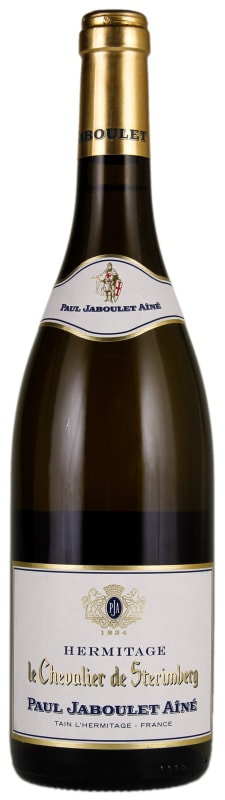


Winemaker Notes
Powerful and fragrant nose of peaches, white flowers and lemongrass. The taste of minerals in inescapable, allowing this broad-shouldered Hermitage Blanc to linger gently on the palate. Bright, energetic, and lip-smackingly delicious.
Blend: 70% Marsanne, 30% Roussanne
Professional Ratings
-
Robert Parker's Wine Advocate
Jaboulet's 2017 Hermitage Blanc Le Chevalier de Sterimberg is approximately two-thirds Marsanne and one-third Roussanne. Subtle notes of crushed stone and pencil shavings frame honey, pineapple and baking spices, all wrapped around a tensile core of tangerine and lime. In a year when no La Chapelle Blanc is being made, this is the top white Hermitage from Jaboulet, and it's a beauty, with a silky texture and a long, mouthwatering finish.
-
Jeb Dunnuck
Brought up just like the Crozes Hermitage Blanc, the 2017 Hermitage Le Chevalier De Sterimberg Blanc is a slightly more Marsanne-dominated effort that offers more minerality and well as reserved notes of spice citrus, crushed rocks, and hints of tangerine. Ultra-pure, seamless, and silky on the palate, it has a beautiful mid-palate as well as a great finish. Purity, freshness, and focus are the buzzwords here.
-
James Suckling
A composed and refined Hermitage with fresh, pear and apple aromas, as well as pastry-like, savory complexity. Plenty of interest here. The palate has a bright, tangy core of acidity and a nice, fine presence of cool apples, pears and white melon. Light, pastry notes to close. From organically grown grapes.
Barrel Sample: 93-94


Full-bodied and flavorful, white Rhône blends originate from France’s Rhône Valley. Today these blends are also becoming popular in other regions. Typically some combination of Grenache Blanc, Marsanne, Roussanne and Viognier form the basis of a white Rhône blend with varying degrees of flexibility depending on the exact appellation. Somm Secret—In the Northern Rhône, blends of Marsanne and Roussanne are common but the south retains more variety. Marsanne, Roussanne as well as Bourboulenc, Clairette, Picpoul and Ugni Blanc are typical.

One of the smallest and most important Syrah regions of northern Rhone, Hermitage is practically one single south-facing slope of crushed granite, thinly covered with varied, yet well-charted soil types. Many climats (well identified parcels) exist within Hermitage and while some smaller producers make single climat Syrahs, some larger ones blend to make one balanced expression of the appellation.
Though the AC regulations allow the addition of up to 15% white grapes to a red Hermitage, in practice it is usually made from Syrah alone. Winemaking is pretty traditional—or you might say historic—with hot fermentations and aging in older barrels of various sizes. The best wines, characterized by deep, dense and sexy flavors of black fruit, cocoa, licorice and tobacco, have massive textures and a solid 10-20 years aging potential.
The region of Hermitage is totally enclosed; the only place it could go really is to literally fall down its own hill into the city of Tain or the Rhone River. Soil erosion is a problem and terraces exist alongside the hill in order to keep the earth in place. Crozes-Hermitage encloses the region entirely to its north and south.
While Hermitage seems synonymous with some of the best Syrah on the planet, actually about one third of the wine produced here comes from white grapes. The full, lush and robust Marsanne or the less common, but almost more charming, Roussanne create wonderful whites in which the best have great potential for aging, like the reds.