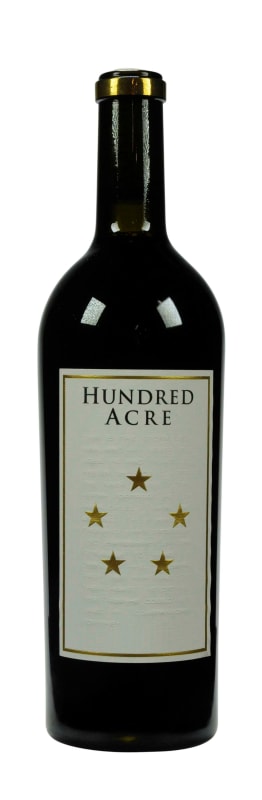


Winemaker Notes
All Hundred Acre wines are made by sorting the fruit berry by berry,fermenting in small French oak fermenters, and long aging in the finest barriques. The secret to Hundred Acre is no compromise and no detail overlooked, ever.
Professional Ratings
-
Robert Parker's Wine Advocate
The 2008 Cabernet Sauvignon Ark Vineyard, a larger site on Howell Mountain, possesses a dense ruby/purple color as well as an extraordinary nose of spring flowers intermixed with blueberries, black raspberries, wet rocks and spice box. Deep, full-bodied, rich and intense, this gorgeous effort again demonstrates what brilliant winemaking and a top-notch terroir can produce. It should drink well for 15-20 years.
Range: 97-99 -
Wine Enthusiast
Deserves its high score by virtue of power and sheer flamboyant dazzle. Packed with ripe, sweet cherries and milk chocolate, with a decadently meaty taste, like beef tartare. Oak plays the usual role, adding a caramelly, buttered tast richness. The tannins are brilliant, so soft and sweet, they're like candy. Drink this flashy wine over the next six years.
-
Wine Spectator
Beautifully done in an ultraripe style. Gushing, with a jammy berry pie mix of wild berry, blackberry and raspberry flavors that are complex and supple. Full-bodied, gaining depth and richness on the long, persistent, tapered finish, which echoes black licorice, loamy earth and spice. Drink now through 2021.


A noble variety bestowed with both power and concentration, Cabernet Sauvignon enjoys success all over the globe, its best examples showing potential to age beautifully for decades. Cabernet Sauvignon flourishes in Bordeaux's Medoc where it is often blended with Merlot and smaller amounts of some combination of Cabernet Franc, Malbecand Petit Verdot. In the Napa Valley, ‘Cab’ is responsible for some of the world’s most prestigious, age-worthy and sought-after “cult” wines. Somm Secret—DNA profiling in 1997 revealed that Cabernet Sauvignon was born from a spontaneous crossing of Cabernet Franc and Sauvignon Blanc in 17th century southwest France.

Today Cabernet Sauvignon is the star of this part of Napa’s rugged, eastern hills, but Zinfandel was responsible for giving the Howell Mountain growing area its original fame in the late 1800s.
Winemaking in Howell Mountain was abandoned during Prohibition, and wasn’t reawakened until the arrival of Randy Dunn, a talented winemaker famous for the success of Caymus in the 1970s and 1980s. In the early eighties, he set his sights on the Napa hills and subsequently astonished the wine world with a Howell Mountain Cabernet Sauvignon. Shortly thereafter Howell Mountain became officially recognized as the first sub-region of Napa Valley (1983).
With vineyards at 1,400 to 2,000 feet in elevation, they predominantly sit above the fog line but the days in Howell Mountain remain cooler than those in the heart of the valley, giving the grapes a bit more time on the vine.
The Howell Mountain AVA includes 1,000 acres of vineyards interspersed by forestlands in the Vaca Mountains. The soils, shallow and infertile with good drainage, are volcanic ash and red clay and produce highly concentrated berries with thick skins. The resulting wines are full of structure and potential to age.
Today Cabernet Sauvignon, Merlot and Petite Sirah thrive in this sub-appellation, as well as its founding variety, Zinfandel.