

Winemaker Notes
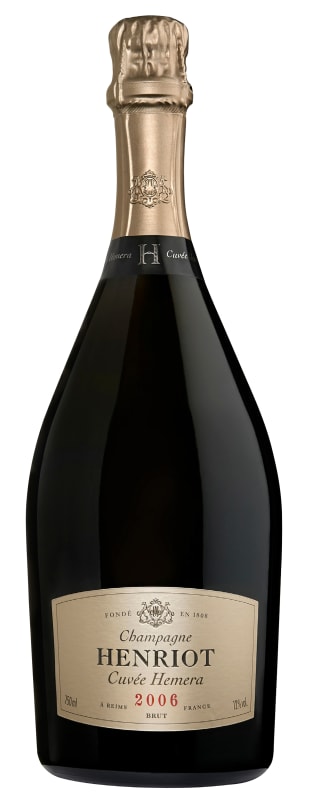
The name Hemera is a tribute to the Greek goddess of daylight and represents this Champagne's lively style and precision, achieved only through winemaking wisdom passed down through the generations and the patient passing of time. The grapes for Cuvée Hemera 2006 are sourced entirely from the six original Grand Cru parcels that founded the house in the early 19th century, with Pinot Noir sourced from Apolline Henriot's original 1808 parcels in the northern Montagne de Reims villages of Mailly Champagne, Verzy, and Verzenay; and Chardonnay sourced from the Côte des Blancs villages of Chouilly, Avize, and Mesnil-sur-Oger from parcels acquired by the family in 1880 through marriage of Apolline’s great grandson, Paul Henriot to Marie Marguet of the Côte des Blancs. In blending these six original Grand Crus together for Cuvée Hemera 2006, Maison Henriot aims to honor its founder, heritage, and well-established legacy of producing prestige cuvées with precision and expertise of the terroirs they are proud to be a steward of.
The 2006 vintage in Champagne was a year of great contrast, which is reflected in the tension and concentration of Cuvée Hemera. The bouquet offers notes of white flower, vanilla, mineral and saline accents characteristic of the chalk parcels of the Côte des Blancs; contrasted by a lively palate of candied fruit, apricot, ripe peach, nectarine, and grapefruit.
Blend: 50% Chardonnay, 50% Pinot Noir
Professional Ratings
-
Wine Enthusiast
This mature wine is finely structured with a delicate mousse and forward toast and brioche flavors. At the same time, the texture and the white fruits are still there, creating a magnificent Champagne with texture and richness in a taut, tight package.
-
James Suckling
Mature and generous nose of baked raspberries, figs, cocoa, honeycomb, marmalade, praline and apricot pie. It’s medium-to full-bodied with vibrant acidity and very creamy bubbles. Saline undertones with lovely salted-caramel notes. Expansive. Equal blend of Grand Cru pinot noir and chardonnay.
-
Wine Spectator
Refined and minerally, with a pleasing plushness to the mouthfeel, this elegant Champagne offers delicate notes of juicy nectarine, grated ginger, toast point and spun honey, all backed by well-knit, zesty acidity, driving the lingering finish with accents of smoke and saline. Drink now through 2030.
-
Decanter
Rich generous hue: gold tinged with hints of green, then a potent aromatic dominated by sherbet, vanillin, redcurrants and praline; the wine immediately assertive and confident, with end of season red apples, fig and praline harnessed in support. The palate is equally complex; initially we have sour honey and Mirabelle plum in the ascendant; then gingerbread, hints of beeswax and even Black Forest gateau! Despite more than a decade on the lees and a modest dosage, it is the richness and generosity which impress at first; more luxuriant, maybe, than the classic Henriot signature, but hallmark elegance and finesse assume control with a little air and a little more time in glass. Thereafter it is the finely poised and almost disciplined finish which provides an elegant counterpoint to the more cavalier declamation of the attack. Dosage: 8g/L. Disgorgement: late 2019.
-
Robert Parker's Wine Advocate
Henriot's newly released 2006 Brut Cuvée Hemera is showing very nicely, offering up aromas of wheat toast, crisp stone fruit, dried white flowers, smoke and iodine. Medium to full-bodied, rich and enveloping, with a generous core of fruit, bright acids and a pretty pinpoint mousse, it concludes with a mouthwateringly sapid finish. The cuvée's rather reductive style marries well with the inherent opulence of the vintage, and it marks a notable step up over the inaugural 2005 in depth and concentration.


Representing the topmost expression of a Champagne house, a vintage Champagne is one made from the produce of a single, superior harvest year. Vintage Champagnes account for a mere 5% of total Champagne production and are produced about three times in a decade. Champagne is typically made as a blend of multiple years in order to preserve the house style; these will have non-vintage, or simply, NV on the label. The term, "vintage," as it applies to all wine, simply means a single harvest year.

Associated with luxury, celebration, and romance, the region, Champagne, is home to the world’s most prized sparkling wine. In order to bear the label, ‘Champagne’, a sparkling wine must originate from this northeastern region of France—called Champagne—and adhere to strict quality standards. Made up of the three towns Reims, Épernay, and Aÿ, it was here that the traditional method of sparkling wine production was both invented and perfected, birthing a winemaking technique as well as a flavor profile that is now emulated worldwide.
Well-drained, limestone and chalky soil defines much of the region, which lend a mineral component to its wines. Champagne’s cold, continental climate promotes ample acidity in its grapes but weather differences from year to year can create significant variation between vintages. While vintage Champagnes are produced in exceptional years, non-vintage cuvées are produced annually from a blend of several years in order to produce Champagnes that maintain a consistent house style.
With nearly negligible exceptions, . These can be blended together or bottled as individual varietal Champagnes, depending on the final style of wine desired. Chardonnay, the only white variety, contributes freshness, elegance, lively acidity and notes of citrus, orchard fruit and white flowers. Pinot Noir and its relative Pinot Meunier, provide the backbone to many blends, adding structure, body and supple red fruit flavors. Wines with a large proportion of Pinot Meunier will be ready to drink earlier, while Pinot Noir contributes to longevity. Whether it is white or rosé, most Champagne is made from a blend of red and white grapes—and uniquely, rosé is often produce by blending together red and white wine. A Champagne made exclusively from Chardonnay will be labeled as ‘blanc de blancs,’ while ones comprised of only red grapes are called ‘blanc de noirs.’