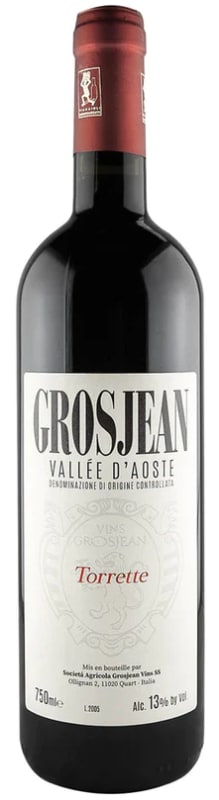


Winemaker Notes
Grosjean’s Torette is charming and delicious in its youth but takes on more weight and gravitas with some bottle age. Bouyed by high acidity and snappy red fruit, the wine is balanced by notes of crushed rocks and earth that make it a perfect pairing for the traditional charcuterie and soups of the Val d’Aoste. An indigenous blend of 80% Petit Rouge together with a varying amount of Vien de Nus, Doucet, Fumin and Mayolet. The vineyard sites are at an altitude of 550-650m and trained using the Guyot system, allowing the vines to drape down the terraced hillside. The wine ages in both stainless steel and oak casks.


Beyond the usual suspects, there are hundreds of red grape varieties grown throughout the world. Some are indigenous specialties capable of producing excellent single varietal wines, while others are better suited for use as blending grapes. Each has its own distinct viticultural characteristics, as well as aroma and flavor profiles, offering much to be discovered by the curious wine lover. In particular, Portugal and Italy are known for having a multitude of unique varieties but they can really be found in any region.

Claiming an impressive list of autochthonous varieties, Valle d'Aosta is a long, narrow valley, formed by Italy’s extreme northwestern Alps. The region, a natural gateway between Italy and France, is also home to many grape migrants from France and its more southerly Italian neighbors. Not surprisingly, wine labels are often written in Italian and French.
The main whites here include: Petite Arvine and Prié blanc (Blanc de Morgex). For reds: Fumin, Cornalin, Mayolet, Petit Rouge, Premetta, Vuillermin, Neblou, and Vien de Nus are unique to the region. French ones that do well are Gamay noir, Pinot noir, Chardonnay and Pinot gris (confusingly called Malvoisie in Aosta but it is not related to Malvasia). Italian grapes common here include Moscato, Dolcetto, Barbera, Nebbiolo, and from farther away, Ciliegiolo.