
Winemaker Notes
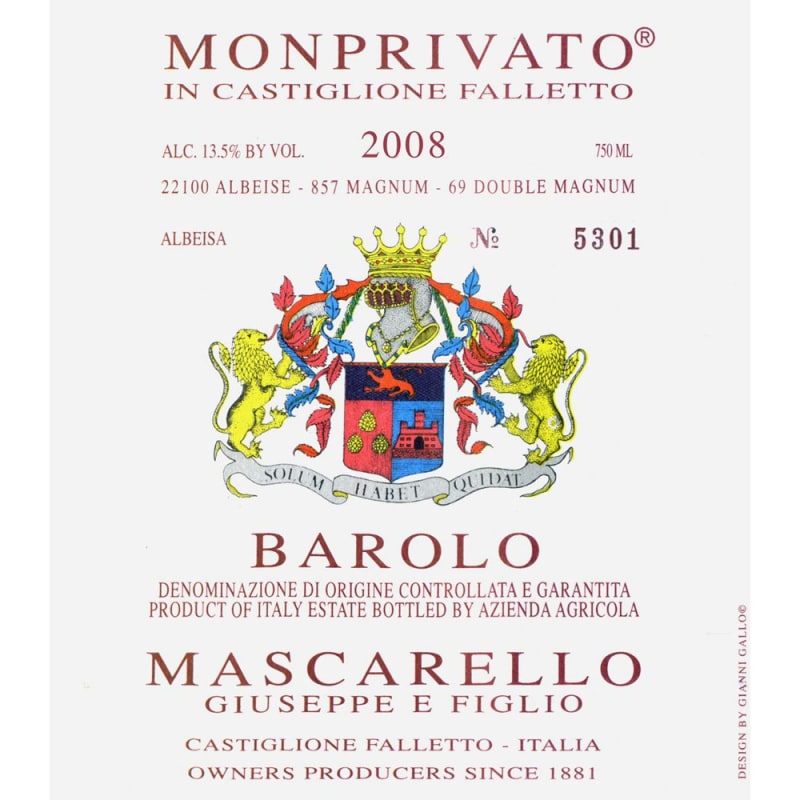
The Mascarello family has grown grapes in Barolo for generations, founding its winery in 1881. Winemaker Mauro Mascarello and son Giuseppe ferment their Nebbiolo in oak vats, leaving it on the skins for roughly three weeks and then aging it three years in large oak casks. Monprivato is a top site covering a south-facing slope just outside the town of Castiglione Falleto, featuring white and gray marl soils that create wines of great perfume and structure, but also elegance.
Professional Ratings
-
Vinous
The 2008 Barolo Monprivato (magnum) remains a wine of total finesse. Deeply pitched aromatics give the 2008 its decidedly exotic flair. Blood orange, mint, hard candy and bright red-toned fruit all play in that same register, showing striking inner sweetness and tons of sheer allure. The 2008 has always been captivating. It is all that and more on this evening.
-
Wine Spectator
Detailed and fragrant, offering floral, strawberry, cherry, licorice and spice flavors, this is elegant and underlined by a strong mineral streak. Well-proportioned, picking up intensity and complexity on the long, savory finish. Extremely fresh and classy.


Responsible for some of the most elegant and age-worthy wines in the world, Nebbiolo, named for the ubiquitous autumnal fog (called nebbia in Italian), is the star variety of northern Italy’s Piedmont region. Grown throughout the area, as well as in the neighboring Valle d’Aosta and Valtellina, it reaches its highest potential in the Piedmontese villages of Barolo, Barbaresco and Roero. Outside of Italy, growers are still very much in the experimentation stage but some success has been achieved in parts of California. Somm Secret—If you’re new to Nebbiolo, start with a charming, wallet-friendly, early-drinking Langhe Nebbiolo or Nebbiolo d'Alba.

The center of the production of the world’s most exclusive and age-worthy red wines made from Nebbiolo, the Barolo wine region includes five core townships: La Morra, Monforte d’Alba, Serralunga d’Alba, Castiglione Falletto and the Barolo village itself, as well as a few outlying villages. The landscape of Barolo, characterized by prominent and castle-topped hills, is full of history and romance centered on the Nebbiolo grape. Its wines, with the signature “tar and roses” aromas, have a deceptively light garnet color but full presence on the palate and plenty of tannins and acidity. In a well-made Barolo wine, one can expect to find complexity and good evolution with notes of, for example, strawberry, cherry, plum, leather, truffle, anise, fresh and dried herbs, tobacco and violets.
There are two predominant soil types here, which distinguish Barolo from the lesser surrounding areas. Compact and fertile Tortonian sandy marls define the vineyards farthest west and at higher elevations. Typically the Barolo wines coming from this side, from La Morra and Barolo, can be approachable relatively early on in their evolution and represent the “feminine” side of Barolo, often closer in style to Barbaresco with elegant perfume and fresh fruit.
On the eastern side of the Barolo wine region, Helvetian soils of compressed sandstone and chalks are less fertile, producing wines with intense body, power and structured tannins. This more “masculine” style comes from Monforte d’Alba and Serralunga d’Alba. The township of Castiglione Falletto covers a spine with both soil types.
The best Barolo wines need 10-15 years before they are ready to drink, and can further age for several decades.