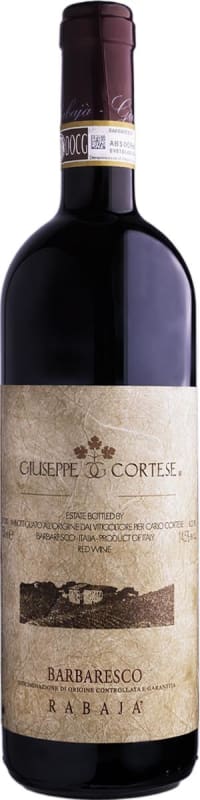


Winemaker Notes
This Barbaresco pairs well with roasted meat or wild game dishes.
Professional Ratings
-
James Suckling
Notes of raspberries, blood orange, ground spices and tree bark. Medium-bodied with juicy acidity, polished tannins and vivid red fruit character. Savory and pure with a supple finish and spiced citrus peel undertones to it.
-
Jeb Dunnuck
Set for a September release, the 2020 Barbaresco Rabaja has a jeweled, transparent appearance and reveals a lovely floral, rosy perfume of ripe wild strawberry, anise, and fresh herbs. It is elegant and has good concentration, with graceful, fine tannins and notes of wild raspberry, peach, and orange peel. It is clean and has a mouthwatering freshness of acidity. Drink 2024-2036.
Rating:93+ -
Robert Parker's Wine Advocate
With earthy notes and some rusty tones, the 2020 Barbaresco Rabajà shows generous fruit flavors from a warm growing season. The wine is open and immediate, requiring not much in terms of waiting time. In fact, it is showing very nicely at this young age with cherry, earth and rose-like aromas to close.
-
Wine Spectator
A bright, cherry-flavored red augmented by earth, licorice, tar and mineral notes. Firm, yet well-balanced, with a lingering, focused finish. Shows fine length, which indicates its potential.
-
Wine Enthusiast
This Barbaresco masterfully balances power and grace. Dried cherries, as if rehydrated with alpine herbs, lift from the glass with the delicate scents of dried rose and sandalwood. The palate is firm, hinting at the need for patient cellaring. Ripe raspberry flavors shine on the palate with a mouthwatering freshness that lifts on the palate with a turned-earth note.


Responsible for some of the most elegant and age-worthy wines in the world, Nebbiolo, named for the ubiquitous autumnal fog (called nebbia in Italian), is the star variety of northern Italy’s Piedmont region. Grown throughout the area, as well as in the neighboring Valle d’Aosta and Valtellina, it reaches its highest potential in the Piedmontese villages of Barolo, Barbaresco and Roero. Outside of Italy, growers are still very much in the experimentation stage but some success has been achieved in parts of California. Somm Secret—If you’re new to Nebbiolo, start with a charming, wallet-friendly, early-drinking Langhe Nebbiolo or Nebbiolo d'Alba.

A wine that most perfectly conveys the spirit and essence of its place, Barbaresco is true reflection of terroir. Its star grape, like that in the neighboring Barolo region, is Nebbiolo. Four townships within the Barbaresco zone can produce Barbaresco: the actual village of Barbaresco, as well as Neive, Treiso and San Rocco Seno d'Elvio.
Broadly speaking there are more similarities in the soils of Barbaresco and Barolo than there are differences. Barbaresco’s soils are approximately of the same two major soil types as Barolo: blue-grey marl of the Tortonion epoch, producing more fragile and aromatic characteristics, and Helvetian white yellow marl, which produces wines with more structure and tannins.
Nebbiolo ripens earlier in Barbaresco than in Barolo, primarily due to the vineyards’ proximity to the Tanaro River and lower elevations. While the wines here are still powerful, Barbaresco expresses a more feminine side of Nebbiolo, often with softer tannins, delicate fruit and an elegant perfume. Typical in a well-made Barbaresco are expressions of rose petal, cherry, strawberry, violets, smoke and spice. These wines need a few years before they reach their peak, the best of which need over a decade or longer. Bottle aging adds more savory characteristics, such as earth, iron and dried fruit.