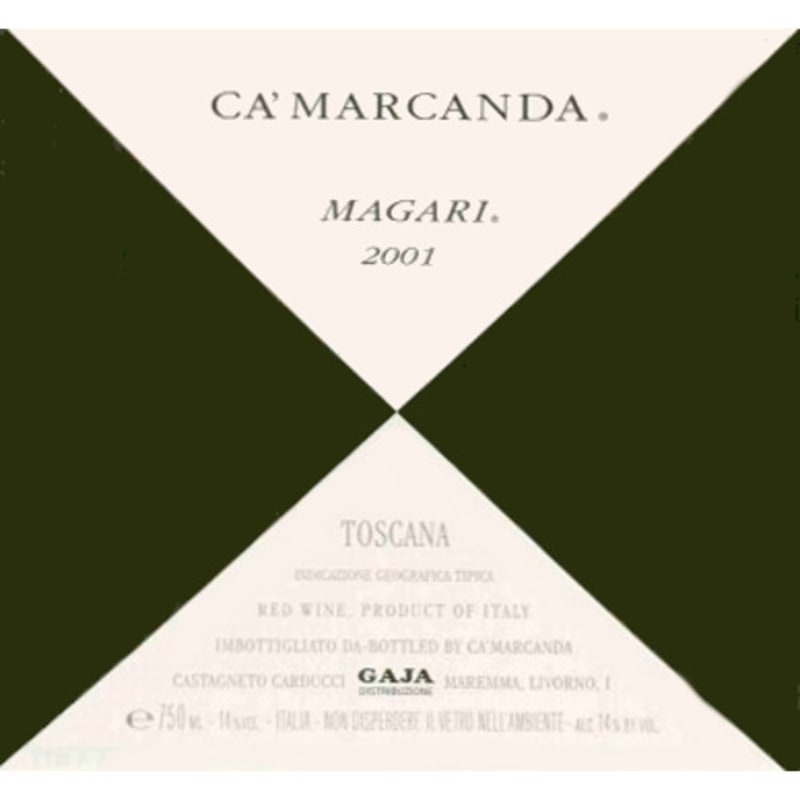
Gaja Ca'Marcanda Magari 2001 Front Label

Winemaker Notes

Magari is an Italian word with several meanings: if only, would that it were true, perhaps. It was chosen because it contains a touch of irony. It is an unassuming name consistent with Angelo Gaja himself. Magari is meant to become Ca'Marcanda's standard bearer.

Complex aromas of flowers, spices and figs with hints of berries. Medium-to-full-bodied, with round and caressing tannins and a long juicy finish.

Professional Ratings

  • 94

    A blend of 50% Merlot, 25% Cabernet Franc and 25% Cabernet Sauvignon, the Ca' Marcanda 2004 Magari is showing beautifully now and continues to hold steady. Nearing the 20-year mark, the bouquet reveals tertiary tones of dried cherry, spice, candied licorice and hints of bitter chocolate. Those classic notes of an aged Tuscan red are enhanced with elegant touches of rusty nail and grilled rosemary in the case of this legendary vintage (one of the first to put this estate on the map). Magari follows to the palate with a pleasantly rich and fleshed-out texture.

Gaja

Gaja

View all products
Gaja, undefined
Gaja Sperss Vineyard Winery Image

Perched atop a steep hill in the Langhe sits the small village of Barbaresco, home of the GAJA winery. The story of the GAJA Winery can be traced to a singular, founding purpose: to produce original wines with a sense of place which reflect the tradition and culture of those who made it. This philosophy has inspired five generations of impeccable winemaking. It started over 150 years ago when Giovanni Gaja opened a small restaurant in Barbaresco, making wine to complement the food he served. In 1859, he founded the Gaja Winery, producing some of the first wine from Piedmont to be bottled and sold outside the region. Since that time, the winery has been shaped by each generation’s hand, notably that of Clotilde Rey, Angelo Gaja’s grandmother. Her passion for uncompromising quality influenced and informed Angelo Gaja. Through Angelo, these values have become the cornerstone of the GAJA philosophy and are engrained in every aspect of wine production

 In 1961, Angelo Gaja began his mission of bringing this great winery to an even higher level. He was the first to use barriques, 225-liter French oak barrels. Under his direction, GAJA pioneered the production of single-vineyard designated wines and was the first to plant Cabernet Sauvignon, Chardonnay and Sauvignon Blanc varietals in Piedmont. He was also instrumental in elevating the native Nebbiolo grape to world-class esteem.

 Angelo Gaja is joined by the fifth generation of the GAJA family – his daughters Gaia and Rossana and his son Giovanni. Together they continue to advance the winery’s legacy. To fully realize their vision, all GAJA wines are produced exclusively from grapes grown in estate-owned vineyards, including 250 acres in Piedmont’s Barbaresco and Barolo districts as well as estates in Pieve Santa Restituta (Montalcino) and Ca’Marcanda (Bolgheri). It is from these storied vineyards, and their terroir – the combination of soil, weather and vines that grow upon them, that GAJA wines reveal their true heart and soul.

Image for Bordeaux Blends content section
View all products

One of the world’s most classic and popular styles of red wine, Bordeaux-inspired blends have spread from their homeland in France to nearly every corner of the New World. Typically based on either Cabernet Sauvignon or Merlot and supported by Cabernet Franc, Malbec and Petit Verdot, the best of these are densely hued, fragrant, full of fruit and boast a structure that begs for cellar time. Somm Secret—Blends from Bordeaux are generally earthier compared to those from the New World, which tend to be fruit-dominant.

Image for Bolgheri Italy content section
View all products

An outstanding wine region made famous by Marchese Mario Incisa della Rocchetta, who planted Cabernet Sauvignon vines for his own consumption in 1940s on his San Guido estate, and called the resulting wine, Sassicaia. Today the region’s Tuscan reds are based on Cabernet Sauvignon and Merlot, which can be made as single varietal wines or blends. The local Sangiovese can make up no more than 50% of the blends. Today Sassicaia has its own DOC designation within the Bogheri DOC appellation.

HEI7234016_2001 Item# 75997