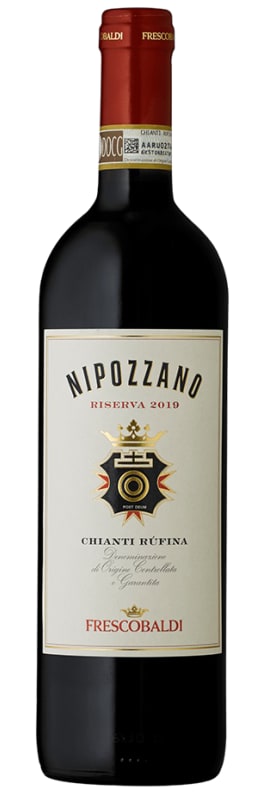


Winemaker Notes
Nipozzano 2019 has a vibrant ruby-red colour. The nose presents fruity hints of berries and black cherry, as well as elegant floral notes. The fresh quality provided by the balsamic notes is simply wonderful. These are followed by roasted and spiced notes of pepper, nutmeg and coffee. On the palate, the wine is rich, characterised by the elegant density of the grapes and the mineral freshness of the finish that make it balanced and persistent. The tannins are dense but not abrasive. The taste and smell correspond beautifully.
Professional Ratings
-
James Suckling
A fruity and bright Nipozzano with currant and cherry aromas and flavors. Juicy and vivid, with some fine tannins. Linear and bright. Lovely energy.
-
Wine Enthusiast
Frescobaldi 2019 Riserva (Chianti Classico). A sweet and lush nose of cedar, vanilla and berries is nonetheless kept in check by savory aromas of pepper, spices and herbs. The palate leans into the spicy side of things alongside cherries and berries, with a saliva-inducing acidity boost.



Frescobaldi’s story is strictly connected with the history of Tuscany. At the high point of medieval Florence, the Frescobaldis spread their influence as bankers, becoming patrons of major works in Florence, such as Santa Trinita bridge and the Basilica of Santo Spirito.
Frescobaldi embodies the essence of Tuscany, its extraordinary vocation for viticulture and the diversity of its territories.
Frescobaldi’s uniqueness stems precisely from the representation of Toscana diversity, from its estates and from wines which express a kaleidoscope of aromas and sensations, springing from the characteristics of each individual terroir. The Estates are positioned in prime areas of Tuscany and each tells its own story, made up of nature, terroir and people.
From Tenuta Castiglioni, where the family’s 700 years of wine-growing history began, to CastelGiocondo on the Montalcino hills, to the timeless Castello Nipozzano. From the hidden gem of Castello Pomino, up to Tenuta Ammiraglia’s new horizons overlooking the sea, to Tenuta Perano a natural amphitheater in the heart of Chianti Classico, ending with Remole, that expresses all the character of Tuscany.
Behind every Frescobaldi wine lies the passion of agronomists and oenologists, who know their vineyards and terroirs down to the finest detail. Their art, creating quality wines, requires the iron rule of respect. Respect for tradition, which guide them, even in the midst of innovation or avant-garde solutions. Respect fort Tuscany, the living land, to be cultivated in harmony and serenity. Respect for each individual terroir, borne of a unique combination of soil, altitude and microclimate, each giving us a wine with its own matchless personality.

Among Italy's elite red grape varieties, Sangiovese has the perfect intersection of bright red fruit and savory earthiness and is responsible for the best red wines of Tuscany. While it is best known as the chief component of Chianti, it is also the main grape in Vino Nobile di Montepulciano and reaches the height of its power and intensity in the complex, long-lived Brunello di Montalcino. Somm Secret—Sangiovese doubles under the alias, Nielluccio, on the French island of Corsica where it produces distinctly floral and refreshing reds and rosés.

Famous for its food-friendly, approachable red wines and their storied history, Chianti is perhaps the best-known wine region of Italy. This appellation within Tuscany has it all: sweeping views of rolling hills, endless vineyards, the warm Mediterranean sun, hearty cuisine and a rich artistic heritage. Chianti includes seven subzones: Chianti Colli Fiorentini, Rufina, Montalbano, Colli Senesi, Colline Pisane, Colli Aretini and Montespertoli, with area beyond whose wines can be labeled simply as Chianti.
However the best quality comes from Chianti Classico, in the heart of the Chianti zone, which is no longer a subzone of the region at all but has been recognized on its own since 1996. The Classico region today is delimited by the confines of the original Chianti zone protected since the 1700s.
Chianti wines are made primarily of Sangiovese, with other varieties comprising up to 25-30% of the blend. Generally, local varieties are used, including Canaiolo, Colorino and Mammolo, but international varieties such as Cabernet Sauvignon, Merlot and Syrah are allowed as long as they are grown within the same zone.
Basic, value-driven Chianti wine is simple and fruit-forward and makes a great companion to any casual dinner. At its apex, Chianti is full bodied but with good acidity, firm tannins, and notes of tart red fruit, dried herbs, fennel, balsamic and tobacco. Chianti Riserva, typically the top bottling of a producer, can benefit handsomely from a decade or two of cellaring.