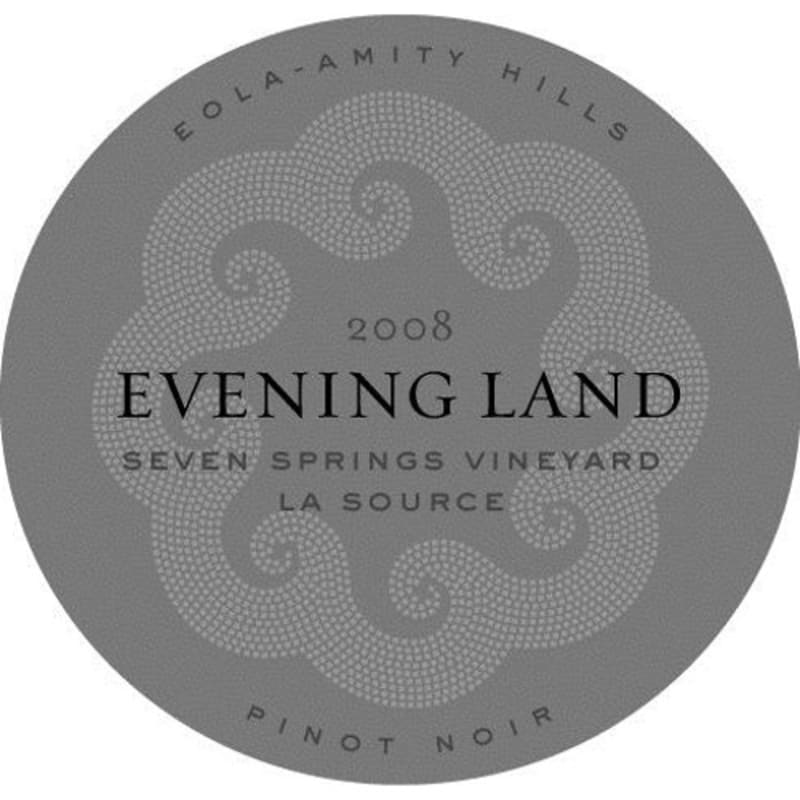

Winemaker Notes
Long a source for benchmark Oregon Pinot Noir, the Seven Springs Vineyard is now a 'monopole' vineyard estate. Seven Springs was first planted in 1981. Occupying the "belly" of an east-facing ridge in the Eola Hills of Oregon's Willamette Valley, the soils of Seven Springs spring from the mineral rich red volcanic rock and are planted to a mix of Oregon Heritage and Dijon clones. Winemaker: Isabelle Meunier with Dominique Lafon, consulting winemaker.
Professional Ratings
-
Wine & Spirits
2008 Eola-Amity Hills La Source Seven Springs Vineyard Pinot Noir held at first under dense blue fruit aromas, with just a little air this wine reveals fine black- and red cherry accents. It continues to evolve over time as the flavors lift off, the fresh, succulent fruit seemingly lit from within, with that high-toned grace on which Oregon originally developed its reputation. It has a hint of the forest floor and a seductive, lingering aftertaste of cherry skin. This could benefit from cellaring; then serve with roast chicken.
-
Robert Parker's Wine Advocate
The 2008 Pinot Noir La Source received the same elevage but was picked from a different parcel of the vineyard. It is slightly darker in color with more perfumed and complex aromatics with the addition of some earthy minerality. Savory, supple, and elegant, it will benefit from 3-4 years of additional bottle age and offer a drinking window extending from 2013 to 2023.


Thin-skinned, finicky and temperamental, Pinot Noir is also one of the most rewarding grapes to grow and remains a labor of love for some of the greatest vignerons in Burgundy. Fairly adaptable but highly reflective of the environment in which it is grown, Pinot Noir prefers a cool climate and requires low yields to achieve high quality. Outside of France, outstanding examples come from in Oregon, California and throughout specific locations in wine-producing world. Somm Secret—André Tchelistcheff, California’s most influential post-Prohibition winemaker decidedly stayed away from the grape, claiming “God made Cabernet. The Devil made Pinot Noir.”

Running north to south, adjacent to the Willamette River, the Eola-Amity Hills AVA has shallow and well-drained soils created from ancient lava flows (called Jory), marine sediments, rocks and alluvial deposits. These soils force vine roots to dig deep, producing small grapes with great concentration.
Like in the McMinnville sub-AVA, cold Pacific air streams in via the Van Duzer Corridor and assists the maintenance of higher acidity in its grapes. This great concentration, combined with marked acidity, give the Eola-Amity Hills wines—namely Pinot noir—their distinct character. While the region covers 40,000 acres, no more than 1,400 acres are covered in vine.