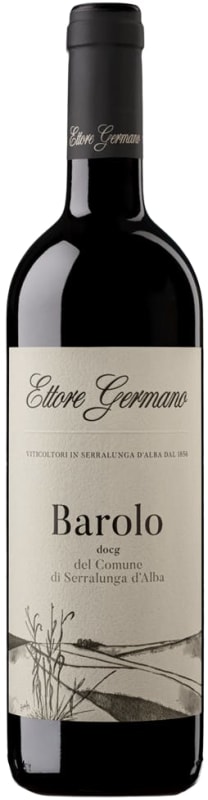


Winemaker Notes
Bright garnet red color. Aromas of strawberry, cherry, pomegranate and rose petals. On the palate red fruits which pack a punch of energy and power that persists to the finish of elegant tannins.
With the idea of a Barolo more ready to drink this wine can be enjoyed with egg based pastas, a roasted chicken or even duck.
Professional Ratings
-
Robert Parker's Wine Advocate
The Ettore Germano 2020 Barolo del Comune di Serralunga d'Alba is very representative of the village with aromas of earthy root and iron ore that fold into floral tones of lavender and dried rose. The wine is quite focused and sharp, but the intensity is not too dialed up. The wine ends with savory tones and loosely knit tannins.
-
Wine Enthusiast
This wine rises from the glass with aromas of a fresh bag of fruits from the green market with ripe raspberry, cherry and blackberry. The fruits combine with wild mint and thyme as mixed spice tickle the nose. The rich palate boasts notes of licorice root, amaro botanicals with a solid core of mixed berries. Powerful, generous and harmonious this is a wine for now or later but will bring smiles for years. Drink Now - 2040.
Barrel Sample: Cellar Selection -
Wine Spectator
Almost lush in texture, this supple red boasts cherry, raspberry, floral, earth and pine flavors. Fluid and open, showing excellent balance, with light tannins gracing the fresh finish. Best from 2027 through 2043.
-
James Suckling
Tarry and savory, with baking spices, dried strawberries, grilled grapefruit and a touch of iron. Firm and medium-bodied on the palate, with juicy, savory fruit and a lengthy finish. Drink or hold.
-
Jeb Dunnuck
A ripe youthful red color, the 2020 Barolo Del Comune Di Serralunga D'Alba is expressive out of the gates, with fresh fruity aromas of cranberry preserve, tangerine, sweet licorice, and dried alpine herbs. It brings forward good energy on the palate, with a linear feel and a delicate texture, fine tannins, a subtle iron mineral tone, and fresh acidity. This charming wine is drinking well now and will show at its best over the coming 5-7 years.


Responsible for some of the most elegant and age-worthy wines in the world, Nebbiolo, named for the ubiquitous autumnal fog (called nebbia in Italian), is the star variety of northern Italy’s Piedmont region. Grown throughout the area, as well as in the neighboring Valle d’Aosta and Valtellina, it reaches its highest potential in the Piedmontese villages of Barolo, Barbaresco and Roero. Outside of Italy, growers are still very much in the experimentation stage but some success has been achieved in parts of California. Somm Secret—If you’re new to Nebbiolo, start with a charming, wallet-friendly, early-drinking Langhe Nebbiolo or Nebbiolo d'Alba.

An historic village situated right in between the famous regions of Barolo and Barbaresco, Alba is also the name for the larger wine region surrounding the village.
In a sense, “Alba” is a catch-all phrase, and includes the declassified Nebbiolo wines made in Barolo and Barbaresco, as well as the Nebbiolo grown just outside of these regions’ borders. In fact, Nebbiolo d’Alba is a softer, less tannic and more fruit-forward wine ready to drink within just a couple years of bottling. It is a great place to start if you want to begin to understand the grape. Likewise, the even broader category of Langhe Nebbiolo offers approachable and value-driven options as well.
Barbera, planted alongside Nebbiolo in the surrounding hills, and referred to as Barbera d’Alba, takes on a more powerful and concentrated personality compared to its counterparts in Asti.
Dolcetto is ubiquitous here and, known as Dolcetto d'Alba, can be found casually served alongside antipasti on the tables of Alba’s cafes and wine bars.
Not surprisingly, given its location, Alba is recognized as one of Italy’s premiere culinary destinations and is the home of the fall truffle fair, which attracts visitors from worldwide every year.