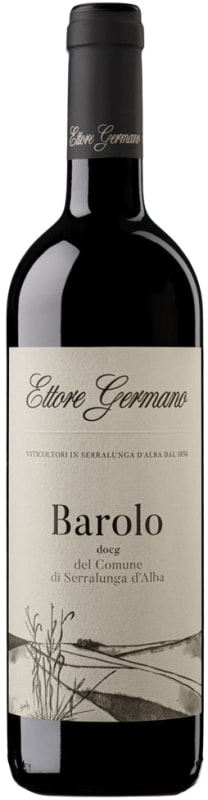


Winemaker Notes
Ettore Germano's Barolo Serralunga is made from hand-picked fruit from young vines in the Prapò, Cerretta and Lazzarito vineyards.
Young and powerfully composed, this Barolo shows aromas and flavors of strawberry, cherry, pomegranate, rose, violet and licorice. The wine is elegant, precise and clear in the mouth.
Enjoy with roast duck and leg of lamb.
Professional Ratings
-
Robert Parker's Wine Advocate
The Ettore Germano 2019 Barolo del Comune di Serralunga d'Alba has a robust fruit profile with dried cherry and blackcurrant. Those aromas segue to dried rosemary, licorice, iron ore and red brick. That metallic earthy quality is a trait often found in the full-bodied Nebbiolos from Serralunga d'Alba.
-
Wine Spectator
Taut and dense, exhibiting cherry, currant, loam, iron and tobacco flavors. Builds on the palate, gaining fruit and refined tannins that define the finish, with excellent balance. Best from 2026 through 2043. 1,300 cases made, 720 cases imported.


Responsible for some of the most elegant and age-worthy wines in the world, Nebbiolo, named for the ubiquitous autumnal fog (called nebbia in Italian), is the star variety of northern Italy’s Piedmont region. Grown throughout the area, as well as in the neighboring Valle d’Aosta and Valtellina, it reaches its highest potential in the Piedmontese villages of Barolo, Barbaresco and Roero. Outside of Italy, growers are still very much in the experimentation stage but some success has been achieved in parts of California. Somm Secret—If you’re new to Nebbiolo, start with a charming, wallet-friendly, early-drinking Langhe Nebbiolo or Nebbiolo d'Alba.

An historic village situated right in between the famous regions of Barolo and Barbaresco, Alba is also the name for the larger wine region surrounding the village.
In a sense, “Alba” is a catch-all phrase, and includes the declassified Nebbiolo wines made in Barolo and Barbaresco, as well as the Nebbiolo grown just outside of these regions’ borders. In fact, Nebbiolo d’Alba is a softer, less tannic and more fruit-forward wine ready to drink within just a couple years of bottling. It is a great place to start if you want to begin to understand the grape. Likewise, the even broader category of Langhe Nebbiolo offers approachable and value-driven options as well.
Barbera, planted alongside Nebbiolo in the surrounding hills, and referred to as Barbera d’Alba, takes on a more powerful and concentrated personality compared to its counterparts in Asti.
Dolcetto is ubiquitous here and, known as Dolcetto d'Alba, can be found casually served alongside antipasti on the tables of Alba’s cafes and wine bars.
Not surprisingly, given its location, Alba is recognized as one of Italy’s premiere culinary destinations and is the home of the fall truffle fair, which attracts visitors from worldwide every year.