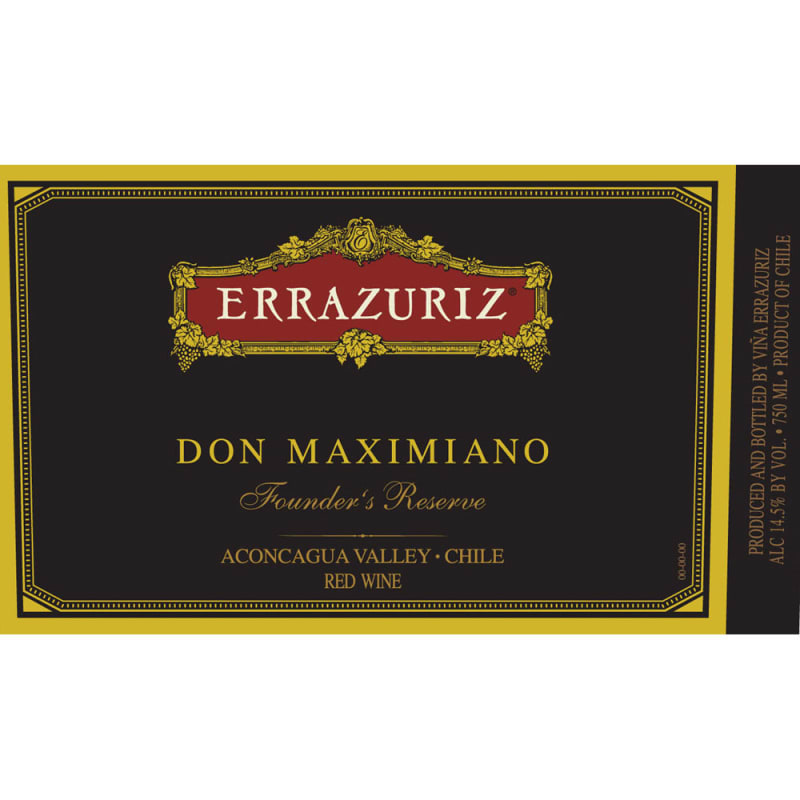

Winemaker Notes
Professional Ratings
-
James Suckling
Intense aromas of flowers, black currants and orange peel. Full-bodied, dense and tight. Yet there's a brooding seriousness to this red. Leave for at least three or four year in bottle. 79% cabernet sauvignon, 10% malbec, 6% carmenere and 5% petit verdot.
-
Decanter
From a cooler vintage, 2013 is notable as the first vintage where 10% Malbec was included in the Don Maximiano blend, along with 79% Cabernet, 6% Carmenere and 5% Petit Verdot. Aged for 22 months in French barriques, 65% new. Poised and expressive, this is evolving beautifully. Layered aromatics: red and black berries interlaced with floral and chocolate notes. Smooth, well integrated tannins lend structure to the core of spicy cassis with a juicy pomegranate note, leading to a fresh, lingering finish.
-
Robert Parker's Wine Advocate
The 2013 Don Maximiano Founder's Reserve, sourced from a cool vintage, is a blend of 79% Cabernet Sauvignon, 10% Malbec, 6% Carménère and 5% Petit Verdot; it fermented in small stainless steel vats and matured in French oak barrels (65% new) for 22 moths. It has a very classical nose, a Bordeaux blend with aromas of blackberries, faint balsamic notes, cedar wood, graphite, cigar box, cracked peppercorns and tobacco leaves. It has a lot less new oak than the vintages of yesteryear. The palate is medium to full-bodied with the telltale Cabernet tannins, juicy fruit, and tension keeping the freshness balancing the sweet fruit. One of the finest versions of Don Maximiano.
-
Wine Enthusiast
Earthy black-olive and foresty herbal scents accent core blackberry and moss aromas. Intense, juicy acidity gives this Cabernet blend vitality across the palate. Herbal berry, olive, pepper and tobacco flavors are spicy on a finish bolstered by brisk, powerful acidity. Drink through 2025.


A noble variety bestowed with both power and concentration, Cabernet Sauvignon enjoys success all over the globe, its best examples showing potential to age beautifully for decades. Cabernet Sauvignon flourishes in Bordeaux's Medoc where it is often blended with Merlot and smaller amounts of some combination of Cabernet Franc, Malbecand Petit Verdot. In the Napa Valley, ‘Cab’ is responsible for some of the world’s most prestigious, age-worthy and sought-after “cult” wines. Somm Secret—DNA profiling in 1997 revealed that Cabernet Sauvignon was born from a spontaneous crossing of Cabernet Franc and Sauvignon Blanc in 17th century southwest France.

The Aconcagua River runs east from the charming costal town of Valparaiso and bisects the land creating the valley after which it was named. While alluvial soils predominate the Aconcagua Valey along its river throughout, its east-west flow creates drastically different conditions on each of its ends. Its western, seaside vineyards, with clay and stony soils upon gently rolling hills, produce cool-climate varieties such as Sauvignon Blanc, Chardonnay and Pinot Noir. Its inner region is one of Chile’s hottest and produces some of its best red wines. Panquehue in the inner Aconcagua is the site of Chile’s first Syrah vines, planted in 1993.