
Winemaker Notes
Professional Ratings
-
James Suckling
A gorgeous and refined red with wonderfully polished tannins and texture. Full to medium body, with harmony. Aftertaste of delicate chocolate, light berry, and mineral. Drink or hold. 78% cabernet sauvignon, 10% carmenere, 7% petit verdot, and 5% syrah.
-
Robert Parker's Wine Advocate
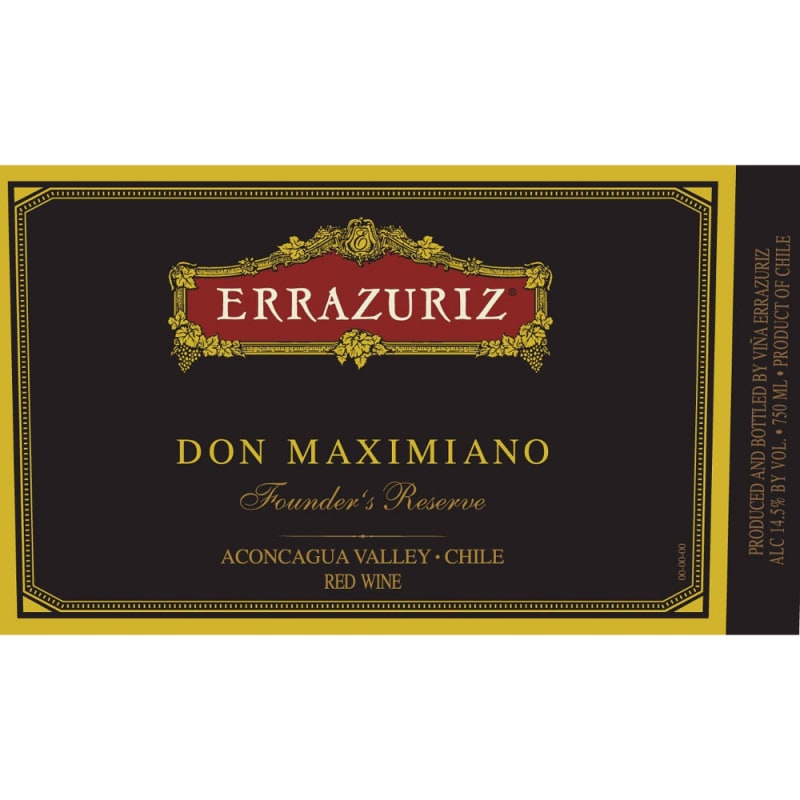
The 2010 Don Maximiano Founder's Reserve is a blend of 78% Cabernet Sauvignon, 10% Carmenere, 7% Petit Verdot and 5% Syrah aged for 22 months in French oak, of which 81% is new. It has a lush, ripe, rounded bouquet with well-integrated oak, again, more floral in style than the 2008 or 2009, more feminine and generous. The palate is medium-bodied with ripe blackberry and raspberry fruit as well as fine tannins. Finally, after so many years, I feel that the oak is in synch and not subjugating the fruit, rendering this a far more impressive Cabernet that gives pleasure. Drink 2014-2025.
-
Wine Enthusiast
Floral aromas of cassis and plum are open, spicy and complex, with a balsamic accent. This feels solid as a rock, with firm tannins and a lively flavor profile that includes blackberry, baked notes, spice and cocoa powder. On the finish, oak is reflected through flavors of vanilla and mocha. Drink from 2014–2022.


A noble variety bestowed with both power and concentration, Cabernet Sauvignon enjoys success all over the globe, its best examples showing potential to age beautifully for decades. Cabernet Sauvignon flourishes in Bordeaux's Medoc where it is often blended with Merlot and smaller amounts of some combination of Cabernet Franc, Malbecand Petit Verdot. In the Napa Valley, ‘Cab’ is responsible for some of the world’s most prestigious, age-worthy and sought-after “cult” wines. Somm Secret—DNA profiling in 1997 revealed that Cabernet Sauvignon was born from a spontaneous crossing of Cabernet Franc and Sauvignon Blanc in 17th century southwest France.

The Aconcagua River runs east from the charming costal town of Valparaiso and bisects the land creating the valley after which it was named. While alluvial soils predominate the Aconcagua Valey along its river throughout, its east-west flow creates drastically different conditions on each of its ends. Its western, seaside vineyards, with clay and stony soils upon gently rolling hills, produce cool-climate varieties such as Sauvignon Blanc, Chardonnay and Pinot Noir. Its inner region is one of Chile’s hottest and produces some of its best red wines. Panquehue in the inner Aconcagua is the site of Chile’s first Syrah vines, planted in 1993.