

Winemaker Notes
Professional Ratings
-
Robert Parker's Wine Advocate
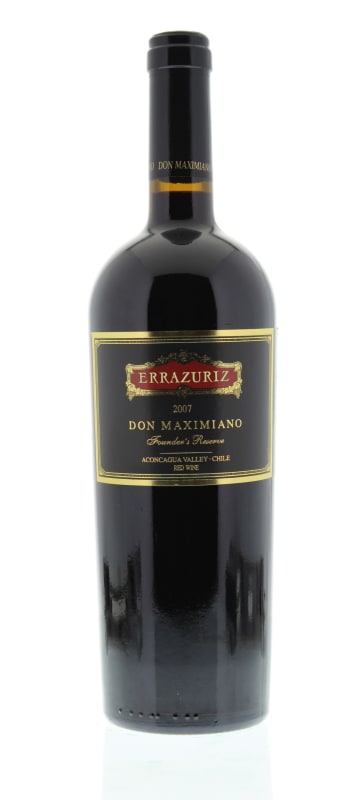
The 2007 Don Maximiano Founder’s Reserve is composed of 82% Cabernet Sauvignon, 6% Petit Verdot, 6% Cabernet Franc, and 6% Syrah that spent 20 months in new French oak. A glass-coating opaque purple color, it surrenders an enticing nose of toasty new oak, graphite, scorched earth, cinnamon, clove, violets, blueberry, and blackberry. On the palate, it reveals a suave personality that combines elegance and power. Impeccably balanced, it has the structure to evolve for 4-6 years and should provide pleasure through 2027.
Rating: 94+ -
Wine Enthusiast
Deep and dense wine, with beet, floral and black fruit aromas. The palate offers good acidity, balance, richness and complexity, while the flavor profile of raspberry, plum and dry herbs is attractive. Finishes mildly toasty, with a hint of herbs and tomato. Best from 2011–14.
-
Wine Spectator
Rich and ripe, with nicely polished focus to the mocha, tobacco, mulled currant and fig notes, all backed by coffee and dark licorice notes on the lengthy finish. There's nice underlying grip. Cabernet Sauvignon, Syrah and Petit Verdot. Drink now through 2011. 100 cases imported.


A noble variety bestowed with both power and concentration, Cabernet Sauvignon enjoys success all over the globe, its best examples showing potential to age beautifully for decades. Cabernet Sauvignon flourishes in Bordeaux's Medoc where it is often blended with Merlot and smaller amounts of some combination of Cabernet Franc, Malbecand Petit Verdot. In the Napa Valley, ‘Cab’ is responsible for some of the world’s most prestigious, age-worthy and sought-after “cult” wines. Somm Secret—DNA profiling in 1997 revealed that Cabernet Sauvignon was born from a spontaneous crossing of Cabernet Franc and Sauvignon Blanc in 17th century southwest France.

The Aconcagua River runs east from the charming costal town of Valparaiso and bisects the land creating the valley after which it was named. While alluvial soils predominate the Aconcagua Valey along its river throughout, its east-west flow creates drastically different conditions on each of its ends. Its western, seaside vineyards, with clay and stony soils upon gently rolling hills, produce cool-climate varieties such as Sauvignon Blanc, Chardonnay and Pinot Noir. Its inner region is one of Chile’s hottest and produces some of its best red wines. Panquehue in the inner Aconcagua is the site of Chile’s first Syrah vines, planted in 1993.