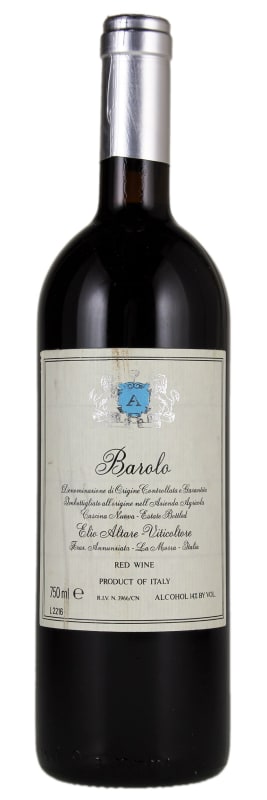


Winemaker Notes
Very intense ruby red with garnet reflections. Fresh scents of small red fruits, raspberry, redcurrant and wild roses that evolve into licorice and spice notes. Warm, elegant, persistent with a long finish, soft tannins.
Serve with red meats and aged cheese.
Professional Ratings
-
Jeb Dunnuck
Layered and inviting aromatics lift from the 2017 Barolo, including kirsch, incense, and dried roses. The palate is highly refined yet also has generous fruit with a beautiful arch noted by cherry lozenge, dried apricot, and orange blossom. This is a remarkable and graceful wine from Elio Altare. Drink 2022-2042.
-
Robert Parker's Wine Advocate
Representing a blend of fruit from Barolo, Castiglione Falletto, La Morra and Novello, the Elio Altare 2017 Barolo sets off the vintage on the right foot. Of course, 2017 delivered all kinds of extreme weather, from frost to dry heat, but this battle-ready Barolo emerges unscathed. Save for the high 15% alcohol content, this wine avoids the classic trappings of a hot vintage. The fruit is not dried out, nor is it jammy. Indeed, this wine shows better balance than most, with a lovely freshness to all that dark and luscious fruit.
-
Wine & Spirits
Deeply colored and densely concentrated, this wine’s black-cherry and berry flavors are gripped by muscular tan-nins that begin to relax with air, showing notes of bay leaf, licorice and dark spice. A rare ribeye would match those brawny tan-nins.
-
Wine Spectator
This red flashes a robust profile, offering dense tannins and texture, all framing cherry, plum, iron, tobacco and spice notes. Winds down gracefully on the finish, with ample fruit flavors to match its structure.


Responsible for some of the most elegant and age-worthy wines in the world, Nebbiolo, named for the ubiquitous autumnal fog (called nebbia in Italian), is the star variety of northern Italy’s Piedmont region. Grown throughout the area, as well as in the neighboring Valle d’Aosta and Valtellina, it reaches its highest potential in the Piedmontese villages of Barolo, Barbaresco and Roero. Outside of Italy, growers are still very much in the experimentation stage but some success has been achieved in parts of California. Somm Secret—If you’re new to Nebbiolo, start with a charming, wallet-friendly, early-drinking Langhe Nebbiolo or Nebbiolo d'Alba.

The center of the production of the world’s most exclusive and age-worthy red wines made from Nebbiolo, the Barolo wine region includes five core townships: La Morra, Monforte d’Alba, Serralunga d’Alba, Castiglione Falletto and the Barolo village itself, as well as a few outlying villages. The landscape of Barolo, characterized by prominent and castle-topped hills, is full of history and romance centered on the Nebbiolo grape. Its wines, with the signature “tar and roses” aromas, have a deceptively light garnet color but full presence on the palate and plenty of tannins and acidity. In a well-made Barolo wine, one can expect to find complexity and good evolution with notes of, for example, strawberry, cherry, plum, leather, truffle, anise, fresh and dried herbs, tobacco and violets.
There are two predominant soil types here, which distinguish Barolo from the lesser surrounding areas. Compact and fertile Tortonian sandy marls define the vineyards farthest west and at higher elevations. Typically the Barolo wines coming from this side, from La Morra and Barolo, can be approachable relatively early on in their evolution and represent the “feminine” side of Barolo, often closer in style to Barbaresco with elegant perfume and fresh fruit.
On the eastern side of the Barolo wine region, Helvetian soils of compressed sandstone and chalks are less fertile, producing wines with intense body, power and structured tannins. This more “masculine” style comes from Monforte d’Alba and Serralunga d’Alba. The township of Castiglione Falletto covers a spine with both soil types.
The best Barolo wines need 10-15 years before they are ready to drink, and can further age for several decades.