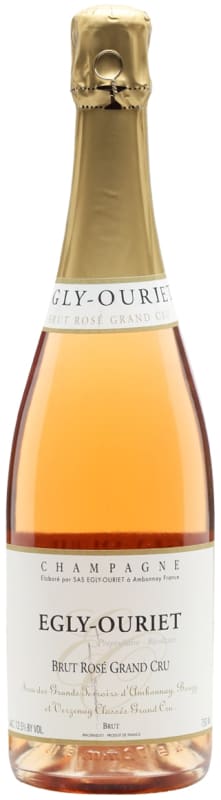


Winemaker Notes
60% Pinot Noir, 40% Chardonnay, with a small addition of Ambonnay Rouge, drawn from cask. A bouquet of roses and small red berries announces the wine's subtle, delicate perfume. The mouth shows more red fruit with a smooth, almost buttery quality; the density and complexity here are unparalleled. White pepper and wet stones follow on a lengthy, lively finish. A superb rosé.
Professional Ratings
-
Robert Parker's Wine Advocate
Disgorged in October 2024 with a dosage of one gram per liter, Egly’s NV Rosé Grand Cru is based on the 2019 vintage, complemented by reserve wines from 2018 and 2017. Composed of 70% Pinot Noir and 30% Chardonnay, with the majority sourced from Ambonnay, it also incorporates 5% red wine from the same village. The wine bursts from the glass with an expressive bouquet of cranberries, redcurrant, brioche and tangerine zest. Medium-bodied and elegant despite its concentration, it is animated by bright acidity and tension, culminating in a precise, mineral finish. This is a fresh-styled rosé Champagne equally suited for refined apéritif moments or food pairings.
-
Vinous
The Extra-Brut Rosé Grand Cru (2017) is bright and nicely lifted, with lovely red berry, floral and mineral character. Crushed red berry fruit, cranberry, chalk, mint and white pepper give the Rosé its brilliant upper register. Medium in body, with crystalline purity, the Rosé dazzles from start to finish. This is an especially airy, taut style. Dosage is 2 grams per liter. Disgorged: September, 2022.


What are the different types of sparkling rosé wine?
Rosé sparkling wines like Champagne, Prosecco, Cava, and others make a fun and festive alternative to regular bubbles—but don’t snub these as not as important as their clear counterparts. Rosé Champagnes (i.e., those coming from the Champagne region of France) are made in the same basic way as regular Champagne, from the same grapes and the same region. Most other regions where sparkling wine is produced, and where red grape varieties also grow, also make a rosé version.
How is sparkling rosé wine made?
There are two main methods to make rosé sparkling wine. Typically, either white wine is blended with red wine to make a rosé base wine, or only red grapes are used but spend a short period of time on their skins (maceration) to make rosé colored juice before pressing and fermentation. In either case the base wine goes through a second fermentation (the one that makes the bubbles) through any of the various sparkling wine making methods.
What gives rosé Champagne and sparkling wine their color and bubbles?
The bubbles in sparkling wine are formed when the base wine undergoes a secondary fermentation, which traps carbon dioxide inside the bottle or fermentation vessel. During this stage, the yeast cells can absorb some of the wine’s color but for the most part, the pink hue remains.
How do you serve rosé sparkling wine?
Treat rosé sparkling wine as you would treat any Champagne, Prosecco, Cava, and other sparkling wine of comparable quality. For storing in any long-term sense, these should be kept at cellar temperature, about 55F. For serving, cool to about 40F to 50F. As for drinking, the best glasses have a stem and a flute or tulip shape to allow the bead (bubbles) and beautiful rosé hue to show.
How long do rosé Champagne and sparkling wine last?
Most rosé versions of Prosecco, Champagne, Cava or others around the “$20 and under” price point are intended for early consumption. Those made using the traditional method with extended cellar time before release (e.g., Champagne or Crémant) can typically improve with age. If you are unsure, definitely consult our Customer Care team for guidance.

Associated with luxury, celebration, and romance, the region, Champagne, is home to the world’s most prized sparkling wine. In order to bear the label, ‘Champagne’, a sparkling wine must originate from this northeastern region of France—called Champagne—and adhere to strict quality standards. Made up of the three towns Reims, Épernay, and Aÿ, it was here that the traditional method of sparkling wine production was both invented and perfected, birthing a winemaking technique as well as a flavor profile that is now emulated worldwide.
Well-drained, limestone and chalky soil defines much of the region, which lend a mineral component to its wines. Champagne’s cold, continental climate promotes ample acidity in its grapes but weather differences from year to year can create significant variation between vintages. While vintage Champagnes are produced in exceptional years, non-vintage cuvées are produced annually from a blend of several years in order to produce Champagnes that maintain a consistent house style.
With nearly negligible exceptions, . These can be blended together or bottled as individual varietal Champagnes, depending on the final style of wine desired. Chardonnay, the only white variety, contributes freshness, elegance, lively acidity and notes of citrus, orchard fruit and white flowers. Pinot Noir and its relative Pinot Meunier, provide the backbone to many blends, adding structure, body and supple red fruit flavors. Wines with a large proportion of Pinot Meunier will be ready to drink earlier, while Pinot Noir contributes to longevity. Whether it is white or rosé, most Champagne is made from a blend of red and white grapes—and uniquely, rosé is often produce by blending together red and white wine. A Champagne made exclusively from Chardonnay will be labeled as ‘blanc de blancs,’ while ones comprised of only red grapes are called ‘blanc de noirs.’