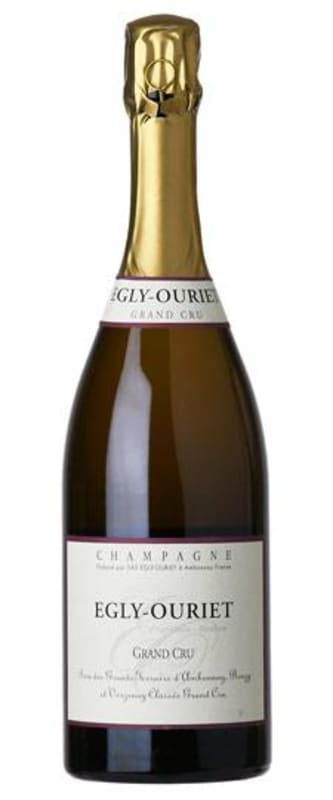


Winemaker Notes
Aromas of fresh pears, light pepper, red fruit. Flavors of mixed red fruits, lemon zest, mixed peppers; creamy
Try pairing with Asian-inspired dishes, well-aged cheeses, or white meats.
Please note, this wine was previously Egly’s Brut Tradition. The wine's blend and aging practices remains the same. Customers might receive one of either two possible labels/names. Specific labels cannot be requested.
Professional Ratings
-
James Suckling
Tight, almost austere. Very chalky and mineral, showing strawberries and fresh apples with tarte tatin complexity. Violets, ginger and vibrant citrus as well. Medium-bodied with pinprick bubbles and some vinous character on the structured palate. Depth, energy and singed-bread flavors. Refined finish. 70% pinot noir and 30% chardonnay. So elegant. Drink or hold.
-
Decanter
Although this appears as the 'house' non-vintage, in character it is more akin to a vintage wine that needs some time on cork. Tasted young, the saturated fruit – apricot, spiced apples, grilled lemons – is already expressive, yet not fully unsprung. Based on 2018 with 40% reserves back to 2016, the heat of 2018 is in the fruit profile rather than weight or grip, and is more about persistence than pure power, underlined by the oak élevage yet not coloured by it. 70% Pinot Noir and 30% Chardonnay from Ambonnay, Bouzy and Verzenay. 100% barrel fermentation.
-
Robert Parker's Wine Advocate
Based on the generously structured 2019 vintage defined by a concentrated and small yield, with 50% reserve wines from 2018 and 2017, Egly's latest NV Grand Cru was disgorged in October 2024 with two grams per liter dosage. As always, it was sourced mainly from Ambonnay, complemented by 20% of fruit from Bouzy, Verzenay and Verzy. Soaring from the glass with scents of pear, pastries, peach and honeysuckle mingling with orange zest, it is medium- to full-bodied, concentrated and rich, supported by tangy acidity and concluding with a long, saline finish. Rating: 92+
-
Wine Spectator
Rich and compact, this mouthwatering version opens on the creamy palate, with aromas and flavors of dried apricot, roasted almond, cherry blossoms and honeycomb expanding through the lasting, salty finish. Disgorged November 2021. Drink now. 98 cases imported.


A term typically reserved for Champagne and Sparkling Wines, non-vintage or simply “NV” on a label indicates a blend of finished wines from different vintages (years of harvest). To make non-vintage Champagne, typically the current year’s harvest (in other words, the current vintage) forms the base of the blend. Finished wines from previous years, called “vins de reserve” are blended in at approximately 10-50% of the total volume in order to achieve the flavor, complexity, body and acidity for the desired house style. A tiny proportion of Champagnes are made from a single vintage.
There are also some very large production still wines that may not claim one particular vintage. This would be at the discretion of the winemaker’s goals for character of the final wine.

Associated with luxury, celebration, and romance, the region, Champagne, is home to the world’s most prized sparkling wine. In order to bear the label, ‘Champagne’, a sparkling wine must originate from this northeastern region of France—called Champagne—and adhere to strict quality standards. Made up of the three towns Reims, Épernay, and Aÿ, it was here that the traditional method of sparkling wine production was both invented and perfected, birthing a winemaking technique as well as a flavor profile that is now emulated worldwide.
Well-drained, limestone and chalky soil defines much of the region, which lend a mineral component to its wines. Champagne’s cold, continental climate promotes ample acidity in its grapes but weather differences from year to year can create significant variation between vintages. While vintage Champagnes are produced in exceptional years, non-vintage cuvées are produced annually from a blend of several years in order to produce Champagnes that maintain a consistent house style.
With nearly negligible exceptions, . These can be blended together or bottled as individual varietal Champagnes, depending on the final style of wine desired. Chardonnay, the only white variety, contributes freshness, elegance, lively acidity and notes of citrus, orchard fruit and white flowers. Pinot Noir and its relative Pinot Meunier, provide the backbone to many blends, adding structure, body and supple red fruit flavors. Wines with a large proportion of Pinot Meunier will be ready to drink earlier, while Pinot Noir contributes to longevity. Whether it is white or rosé, most Champagne is made from a blend of red and white grapes—and uniquely, rosé is often produce by blending together red and white wine. A Champagne made exclusively from Chardonnay will be labeled as ‘blanc de blancs,’ while ones comprised of only red grapes are called ‘blanc de noirs.’