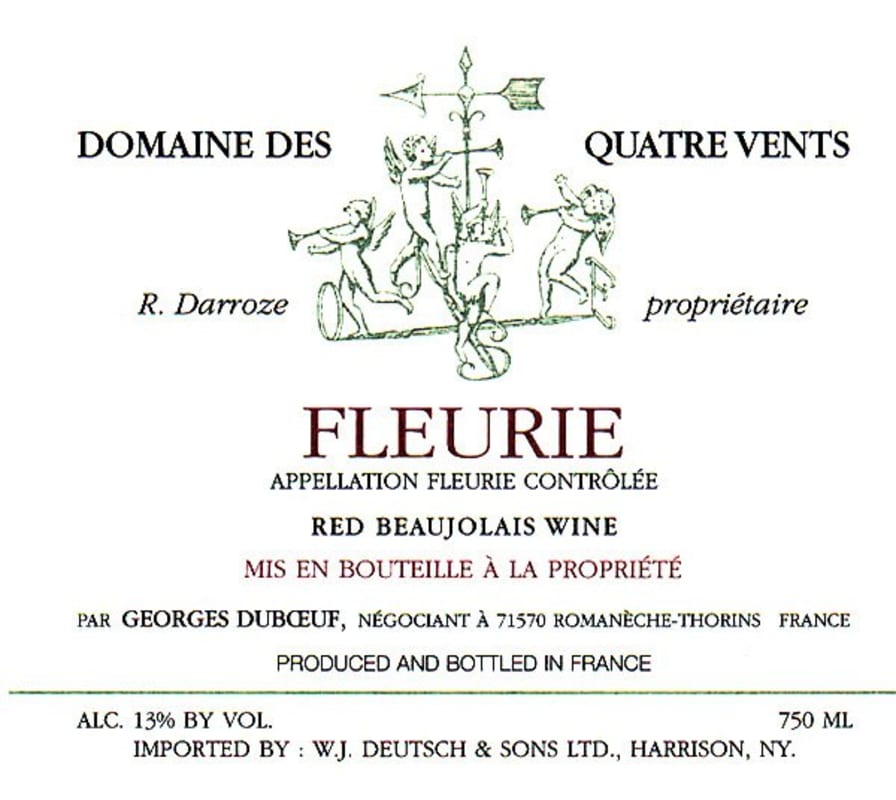

Winemaker Notes
Professional Ratings
-
Robert Parker's Wine Advocate
The Duboeuf 2009 Fleurie Clos des Quatre Vents – tasted from tank; and as usual, a cuvee from old vines treated to long, cool fermentation – displays ripe blackberry and blueberry, ocean breeze, black tea, borage, and bittersweet iris perfume in the nose. Silken and expansive on the palate, this is a little less intriguing but even more generous than the corresponding Fleurie Grand Pre, finishing with soothing yet stimulating length, and likely to be worth following for 3-4 years. A very ripe and concentrated but awkwardly woody “Prestige” bottling of Fleurie did not give me much hope for its post-bottling evolution.
Range: 90-91 -
Wine & Spirits
Scents of crushed rose petals add to the cool, black cherry fruit intensity of this wine. The earthy grit of the tannin balances the fruit with a scent of the soil, finishing tight, peppery and potent. It's structured to age for several years and to match braised tripe or other earthy meats.


Delightfully playful, but also capable of impressive gravitas, Gamay is responsible for juicy, berry-packed wines. From Beaujolais, Gamay generally has three classes: Beaujolais Nouveau, a decidedly young, fruit-driven wine, Beaujolais Villages and Cru Beaujolais. The Villages and Crus are highly ranked grape growing communes whose wines are capable of improving with age whereas Nouveau, released two months after harvest, is intended for immediate consumption. Somm Secret—The ten different Crus have their own distinct personalities—Fleurie is delicate and floral, Côte de Brouilly is concentrated and elegant and Morgon is structured and age-worthy.

The bucolic region often identified as the southern part of Burgundy, Beaujolais actually doesn’t have a whole lot in common with the rest of the region in terms of climate, soil types and grape varieties. Beaujolais achieves its own identity with variations on style of one grape, Gamay.
Gamay was actually grown throughout all of Burgundy until 1395 when the Duke of Burgundy banished it south, making room for Pinot Noir to inhabit all of the “superior” hillsides of Burgundy proper. This was good news for Gamay as it produces a much better wine in the granitic soils of Beaujolais, compared with the limestone escarpments of the Côte d’Or.
Four styles of Beaujolais wines exist. The simplest, and one that has regrettably given the region a subpar reputation, is Beaujolais Nouveau. This is the Beaujolais wine that is made using carbonic maceration (a quick fermentation that results in sweet aromas) and is released on the third Thursday of November in the same year as harvest. It's meant to drink young and is flirty, fruity and fun. The rest of Beaujolais is where the serious wines are found. Aside from the wines simply labelled, Beaujolais, there are the Beaujolais-Villages wines, which must come from the hilly northern part of the region, and offer reasonable values with some gems among them. The superior sections are the cru vineyards coming from ten distinct communes: St-Amour, Juliénas, Chénas, Moulin-à-Vent, Fleurie, Chiroubles, Morgon, Regnié, Brouilly, and Côte de Brouilly. Any cru Beajolais will have its commune name prominent on the label.