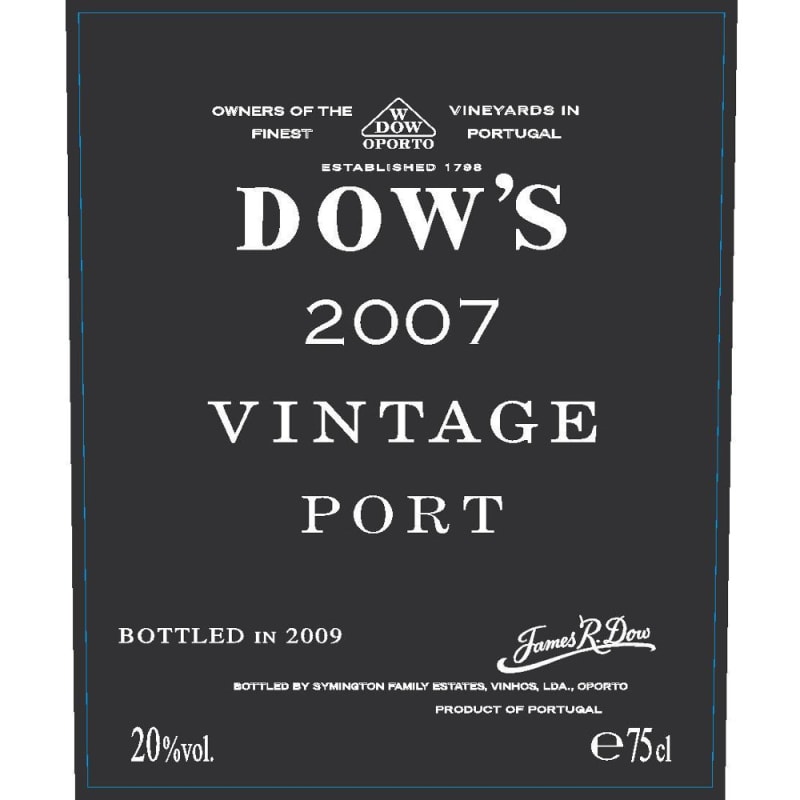

Winemaker Notes
2007 was undoubtedly one of the best years we have ever seen for Touriga Nacional, a variety that can suffer from excessive heat. The cooler temperatures registered during the final growing period paved the way for ideal maturations, lending the Nacional excellent sugar/acidity balance and ideal phenolic ripeness. We therefore decided on a final blend that comprised of 54% Touriga Nacional. The latter was sourced from low-yielding parcels of the Bomfim vineyard, which produced wines with Dow's typically austere character and also from Senhora da Ribeira which by comparison delivered slightly richer wines.
Professional Ratings
-
Wine Spectator
Amazing aromas of lilac, violet, crushed blueberry and mineral that turn to black pepper and spices follow through to a full-bodied, medium-sweet palate, with a long, chewy finish. Evolves to tar and asphalt. Really held back, yet powerful grip slaps you. This is mind-blowing in texture. The greatest Dow ever made. Best after 2022.
-
Wine Enthusiast
A solidly structured wine, packed with initially sweet fruit that then becomes drier as the ripe tannins show through. All the ingredients are there, supported by a tense texture to go with the first sweetness. It’s an exciting wine, obviously very ageworthy.
-
Robert Parker's Wine Advocate
The 2007 Dow's Vintage Port is one of the stars of the vintage. A glass-coating opaque purple color, it offers up an already complex bouquet of mineral, pencil lead, licorice, spice box, and assorted black fruits. On the palate it is quite massive, slightly dry in the house style, and packed with fruit. It has the structure to be one of the long distance runners of the vintage taking as much as 20 years to reach its peak and drinking well through 2050. As an aside, I was able to taste the individual components of this wine on the day prior to this tasting. The final blend is better than any of its parts.
-
Wine & Spirits
The color shows the intense concentration of this wine, its deep purple edge predicting the big bite of fruit up front. The bold berry and plum flavors are round, supple and ripe, completely filling the mouth before settling into the schist of the tannin and the char of the oak. Dow is often compressed and hard to read as a young vintage release: This inky 2007 may well make the current rating seem conservative as it expands with age. Check on it 30 years from the vintage.


Port is a sweet, fortified wine with numerous styles: Ruby, Tawny, Vintage, Late Bottled Vintage (LBV), White, Colheita, and a few unusual others. It is blended from from the most important red grapes of the Douro Valley, based primarily on Touriga Nacional with over 80 other varieties approved for use. Most Ports are best served slightly chilled at around 55-65°F. To learn more, see our full Port Wine Guide

The home of Port—perhaps the most internationally acclaimed beverage—the Douro region of Portugal is one of the world’s oldest delimited wine regions, established in 1756. The vineyards of the Douro, set on the slopes surrounding the Douro River (known as the Duero in Spain), are incredibly steep, necessitating the use of terracing and thus, manual vineyard management as well as harvesting. The Douro's best sites, rare outcroppings of Cambrian schist, are reserved for vineyards that yield high quality Port.
While more than 100 indigenous varieties are approved for wine production in the Douro, there are five primary grapes that make up most Port and the region's excellent, though less known, red table wines. Touriga Nacional is the finest of these, prized for its deep color, tannins and floral aromatics. Tinta Roriz (Spain's Tempranillo) adds bright acidity and red fruit flavors. Touriga Franca shows great persistence of fruit and Tinta Barroca helps round out the blend with its supple texture. Tinta Cão, a fine but low-yielding variety, is now rarely planted but still highly valued for its ability to produce excellent, complex wines.
White wines, generally crisp, mineral-driven blends of Arinto, Viosinho, Gouveio, Malvasia Fina and an assortment of other rare but local varieties, are produced in small quantities but worth noting.
With hot summers and cool, wet winters, the Duoro has a maritime climate.