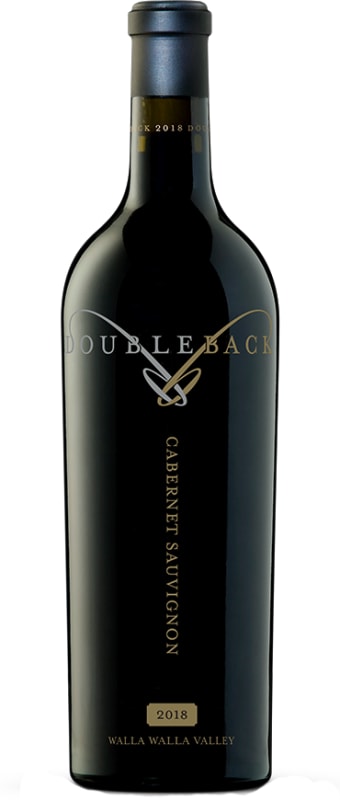


Winemaker Notes
Crème de cassis, black currant, blackberry, wafts of dried cranberry, a hint of wet gravel after a fresh rain and pencil shavings. The richness of this wine is a love affair- chewy tannins and a long, long finish is high display here. Everything is in balance.
Professional Ratings
-
Jeb Dunnuck
The 2018 Cabernet Sauvignon (90% Cabernet Sauvignon and 5% each of Malbec and Merlot) comes from a handful of sites in the Walla Walla Valley and spent 23 months in 67% new French oak. Classic, old-school notes of blackcurrants, leafy tobacco, earth, saddle leather, and spicy herbs gives way to full-bodied Cabernet Sauvignon with notable balance, a great mid-palate, ripe yet building tannins, and a great finish. This pure, clean, classic Cabernet will benefit from 3-4 years of bottle age and keep for 20 years or more. It's beautifully done.
-
Wine & Spirits
Doubleback’s Walla Walla cabernet bottling blends the fruit of estate vineyards with some from the Figgins Estate in Mill Creek. Aged in oak (two-thirds new) and concrete, this wine sings of the 2018 vintage, starting tense and lean then broadening with air, becoming suave and linear, a black cherry lining for a dark velvet coat. It has more pro-nounced acidity than in prior vintages, mak-ing it lively and immediate.
-
Wine Spectator
Well-knit and compelling for its rich blackberry, black olive and stony mineral accents, which gather richness and tension toward refined tannins.
-
James Suckling
Aromas of blackcurrants, dried violets, walnuts and sweet tobacco. It’s medium-to full-bodied with firm tannins. Firm and structured with fresh acidity and a gently leafy undertone. Try from 2023.
-
Robert Parker's Wine Advocate
Displaying a deep ruby core and purple highlights at the rim, the 2018 Cabernet Sauvignon opens with fresh, ripe and juicy fruit tones of Chambord, crème de cassis and plum reduction before offering elements of lavender and violet in the glass. Full-bodied and juicy, the palate is generous, showing dusty tannins that will take some time to subside. It ends with persistent flavors of crème de violette, stewed blackberries and clove. The wine rested for about two years in two-thirds new French oak barrels before being bottled.


A noble variety bestowed with both power and concentration, Cabernet Sauvignon enjoys success all over the globe, its best examples showing potential to age beautifully for decades. Cabernet Sauvignon flourishes in Bordeaux's Medoc where it is often blended with Merlot and smaller amounts of some combination of Cabernet Franc, Malbecand Petit Verdot. In the Napa Valley, ‘Cab’ is responsible for some of the world’s most prestigious, age-worthy and sought-after “cult” wines. Somm Secret—DNA profiling in 1997 revealed that Cabernet Sauvignon was born from a spontaneous crossing of Cabernet Franc and Sauvignon Blanc in 17th century southwest France.

Responsible for some of Washington’s most highly acclaimed wines, the Walla Walla Valley has experienced a surge in popularity in recent years and is home to both historic wineries and younger, up-and-coming producers.
The Walla Walla Valley, a Native American name meaning “many waters,” is located in southeastern Washington; part of the appellation actually extends into Oregon. Soils here are well-drained, sandy loess over Missoula Flood deposits and fractured basalt.
It is a region perfectly suited to Rhône-inspired Syrahs, distinguished by savory notes of red berry, black olive, smoke and fresh earth. Cabernet Sauvignon and Merlot create a range of styles from smooth and supple to robust and well-structured. White varieties are rare but some producers blend Sauvignon Blanc with Sémillon, resulting in a rich and round style, and plantings of Viognier, while minimal, are often quite successful.
Of note within Walla Walla, is one new and very peculiar appellation, called the Rocks District of Milton-Freewater. This is the only AVA in the U.S. whose boundaries are totally defined by the soil type. Soils here look a bit like those in the acclaimed Rhône region of Chateauneuf-du-Pape, but are large, ancient, basalt cobblestones. These stones work in the same way as they do in Chateauneuf, absorbing and then radiating the sun's heat up to enhance the ripening of grape clusters. The Rocks District is within the part of Walla Walla that spills over into Oregon and naturally excels in the production of Rhône varieties like Syrah, as well as the Bordeaux varieties.