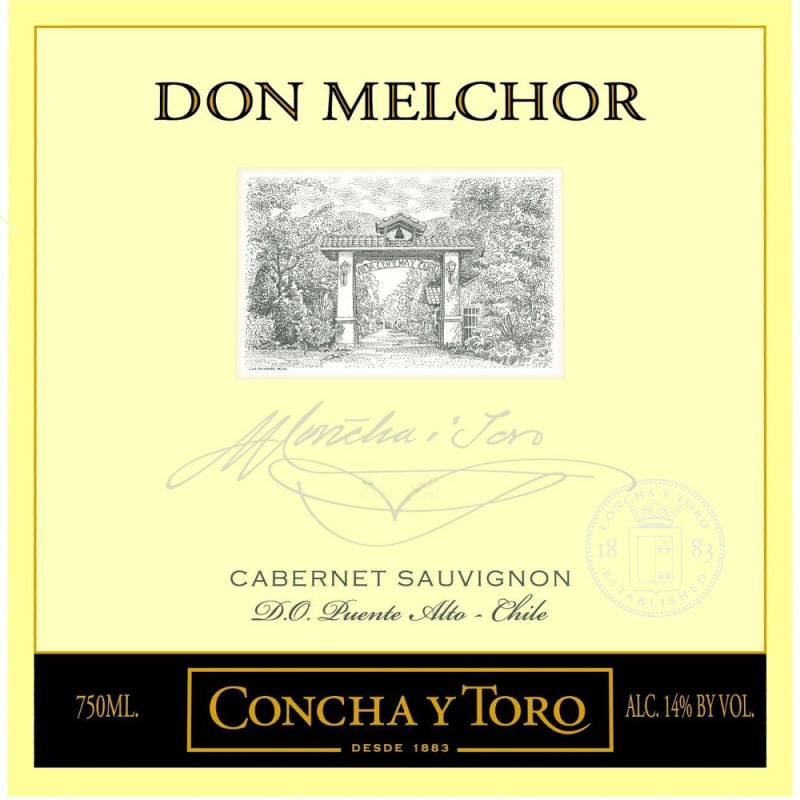

Winemaker Notes
Deep cherry red in the glass. The aroma of this wine is elegant and complex, brimming with notes of black currants and spice complemented by chocolate and tobacco. Soft tannins give way to evolving freshness with an elegant, persistent finish.
Professional Ratings
-
James Suckling
Pretty aromas of blueberries with hints of sandalwood and cedar. Full body, with very integrated tannins and a wonderfully polished texture. The finish is extremely long and intense. Serious density and class to this. A blend of 97% cabernet sauvignon and 3% cabernet franc.
-
Wine Spectator
In 2010, Chile’s Puente Alto appellation saw a slightly cooler-than-usual growing season, and winemaker Enrique Tirado used the weather to his advantage, allowing the Cabernet Sauvignon grapes, grown on alluvial soils, to hang on the vines longer than usual. The result is this particularly elegant version of the flagship Don Melchor. Blended with 3 percent Cabernet Franc, the wine aged in French oak barrels for 15 months. Concha y Toro, owned by the Guilisasti family, is Chile’s largest wine company.
-
Wine & Spirits
This classic Alto Maipo cabernet grows at Tocornal, on vines planted in the 1970s. It builds from scents of herbs and menthol toward a strong presence of red fruit and spice. The texture is soft and gentle while acidity marks the contours of the mouth with freshness.
-
Robert Parker's Wine Advocate
The 2010 Don Melchor (a homage to Don Melchor Concha y Toro who created Concha y Toro in 1883) is a blend of 97% Cabernet Sauvignon and 3% Cabernet Franc from Alto Maipo, the best terroir for Cabernet Sauvignon in Chile. 2010 was a cool vintage, balanced and fresh. It has aromas of blood and fresh meat, it feels subtle, with signs of youth in the shape of some lactic hints with good freshness, notes of black and red berries, developing some aromas of graphite and cold bonfire with time in the glass. The wine fills your mouth with its sophisticated, fine-grained tannins and has good freshness and length. The wine is quite drinkable now, but if you wait a little, the lactic touch should get more integrated and will age for a long time. I tasted 1993 and 1996 and both are drinking perfectly now: this wine has a track record. The 2010 vintage was launched in March-April 2014. Drink 2015-2025.



Don Melchor, named after Concha Y Toro’s founder, is among Chile’s most-acclaimed wines and a Cabernet that belongs in every conversation about world-class interpretations of this singular varietal. Winemaker Enrique Tirado says of his vision for the wine, “Don Melchor’s style, complexity, and elegance are the extension of the perfect balance between the rocky soils in Puente Alto, the cold winds that slide down from the Andes Mountains, the generous climate of the Maipo Valley, the number of years the vines have taken to yield their best grapes, and the meticulous and caring work of the human hand.”
The signature wine from the exquisitely tended Puente Alto vineyard, Don Melchor celebrates its 30th vintage with the 2016 release. Set at the foot of the Andes Mountains on the northern banks of the Maipo River in the Upper Maipo Valley, 650 meters above sea level, the vineyard dates back to the mid-19th century, when the first pre-phylloxera French varieties were brought to Chile. Today, the vineyard consists of 127 hectares, divided into seven parcels, 90% of which are Cabernet Sauvignon, 7.1% are Cabernet Franc, 1.9% are Merlot, and 1% are Petit Verdot. Each parcel has been subdivided in order for very specific, detailed work that responds to the particular needs of each plant, row by row, to achieve the perfect balance with the weather characteristics of each year. Average vine age is over 30 years.
Every year, Winemaker Enrique Tirado travels to the small town of Lamarque, Bordeaux, France, to meet with renowned Bordeaux consultant Eric Boissenot, to taste approximately 150 lots from the vineyard and determine which lots, and in which proportions, will go into the new vintage of Don Melchor. Once the final blend has been defined, the new vintage of Don Melchor is transferred to French oak barrels from the Allier, Tronçois, and Nevers forests. Nearly two-thirds of the barrels are new, and the remaining third have had one prior use. After 14–15 months, the wine is bottled and aged for another year to develop the complexity and elegance that Don Melchor is known for.

A noble variety bestowed with both power and concentration, Cabernet Sauvignon enjoys success all over the globe, its best examples showing potential to age beautifully for decades. Cabernet Sauvignon flourishes in Bordeaux's Medoc where it is often blended with Merlot and smaller amounts of some combination of Cabernet Franc, Malbecand Petit Verdot. In the Napa Valley, ‘Cab’ is responsible for some of the world’s most prestigious, age-worthy and sought-after “cult” wines. Somm Secret—DNA profiling in 1997 revealed that Cabernet Sauvignon was born from a spontaneous crossing of Cabernet Franc and Sauvignon Blanc in 17th century southwest France.

Dramatic geographic and climatic changes from west to east make Chile an exciting frontier for wines of all styles. Chile’s entire western border is Pacific coastline, its center is composed of warm valleys and on its eastern border, are the soaring Andes Mountains.
Chile’s central valleys, sheltered by the costal ranges, and in some parts climbing the eastern slopes of the Andes, remain relatively warm and dry. The conditions are ideal for producing concentrated, full-bodied, aromatic reds rich in black and red fruits. The eponymous Aconcagua Valley—hot and dry—is home to intense red wines made from Cabernet Sauvignon, Syrah and Merlot.
The Maipo, Rapel, Curicó and Maule Valleys specialize in Cabernet and Bordeaux Blends as well as Carmenère, Chile’s unofficial signature grape.
Chilly breezes from the Antarctic Humboldt Current allow the coastal regions of Casablanca Valley and San Antonio Valley to focus on the cool climate loving varieties, Pinot Noir, Chardonnay and Sauvignon Blanc.
Chile’s Coquimbo region in the far north, containing the Elqui and Limari Valleys, historically focused solely on Pisco production. But here the minimal rainfall, intense sunlight and chilly ocean breezes allow success with Chardonnay and Pinot Noir. The up-and-coming southern regions of Bio Bio and Itata in the south make excellent Riesling, Chardonnay and Pinot Noir.
Spanish settlers, Juan Jufre and Diego Garcia de Cáceres, most likely brought Vitis vinifera (Europe’s wine producing vine species) to the Central Valley of Chile sometime in the 1550s. One fun fact about Chile is that its natural geographical borders have allowed it to avoid phylloxera and as a result, vines are often planted on their own rootstock rather than grafted.