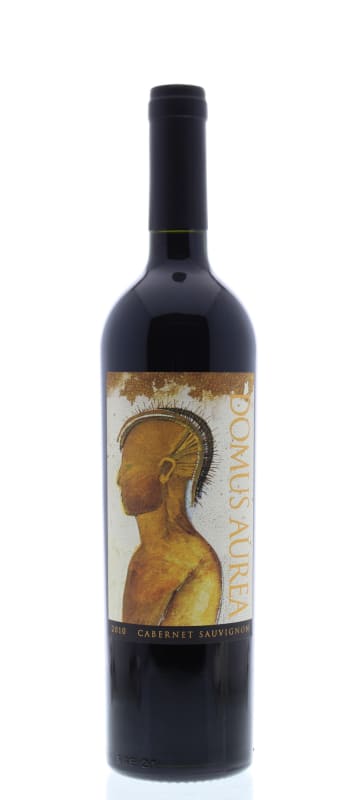


Winemaker Notes
The mouth displays vibrant but soft tannins, a smooth texture, and a long, elegant finish. Another sip reveals hints of berry, balsamic and tobacco. This wine will continue to age well over the next 15-20 years, but drinks beautifully today.
Blend: 85% Cabernet Sauvignon, 9% Cabernet Franc, 4% Petit Verdot, 2% Merlot
Professional Ratings
-
Robert Parker's Wine Advocate
Winemaker Jean-Pascal Lacaze went as far as telling me that 2010 could be a too perfect vintage for Domus Aurea, and the wine does not display the wild character usually identified with it. Let me tell you, for me the wine is simply fantastic. The 2010 Domus Aurea comes from an almost perfect vintage for Maipo that translated into wines with a long aging potential. The wine is always Cabernet-based but contains some 15% other Bordeaux grapes, Cabernet Franc, Petit Verdot and Merlot from their vineyards panted in the 1970s. The nose is subtle, still very young for a wine that has been in bottle for a while; it's not primary but it has not yet developed tertiary arms, there are just bare hints of complexity and development, all of it in a very subtle way, much more elegant and controlled than other vintages. But if the nose is elegant, it is in the palate where you perceive the class of this wine, where everything fits perfectly like in a Swiss watch -- precise, harmonious but at the same time vibrant and deep. It has great freshness. This has the components and the balance to have a long and positive evolution in bottle. I need to taste all of the vintages together (one day...), but so far, this is my favorite vintage ever. At this price level, it has to be one of the cheapest great wines in the world. Super! 25,605 bottles produced. It was bottled in January 2012.
-
James Suckling
Fascinating aromas of green chili and dark fruits with hints of black licorice. Full body, silky tannins and a beautiful finish. This really makes you want to drink it.
-
Wine Spectator
This is filled with ripe and well-extracted flavors of Christmas pudding, black fig and toffee. Dense midpalate, with chocolate nuances and a long, spicy finish that features plenty of smoke and minty notes. Drink now through 2019.


A noble variety bestowed with both power and concentration, Cabernet Sauvignon enjoys success all over the globe, its best examples showing potential to age beautifully for decades. Cabernet Sauvignon flourishes in Bordeaux's Medoc where it is often blended with Merlot and smaller amounts of some combination of Cabernet Franc, Malbecand Petit Verdot. In the Napa Valley, ‘Cab’ is responsible for some of the world’s most prestigious, age-worthy and sought-after “cult” wines. Somm Secret—DNA profiling in 1997 revealed that Cabernet Sauvignon was born from a spontaneous crossing of Cabernet Franc and Sauvignon Blanc in 17th century southwest France.

The Maipo Valley is Chile’s most famous wine region. Set in the country’s Central Valley, it is warm and quite dry, often necessitating the use of irrigation. Alluvial soils predominate but are supplemented with loam and clay.
The climate in Maipo is best-suited for ripe, full-bodied reds like Cabernet Sauvignon (the region’s most widely planted grape), Merlot, Syrah and Carmenère, a Bordeaux variety that has found a successful home in Chile.
White wines are also produced with great prosperity, especially near the cooler coast, include Chardonnay and Sauvignon Blanc.