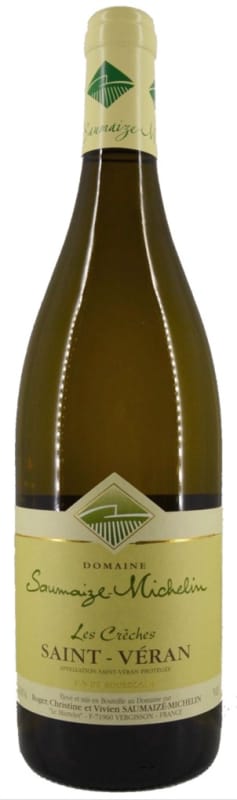


Winemaker Notes
This vineyard is literally adjacent to the soon to be premier cru, Clos sur la Roche vineyard, right on the border with Pouilly-Fuisse.The middle-Jurassic monolith of Sur la Roche towers over the village of Vergisson. Les Creches, which rides the back of the Roche, is most likely limestone from the latest Bajocian to the early-Bathonian 166 to 168 million years ago called Calcaire à Chailles. Chailles are rounded, oblong shaped chert (aka flint) stones which formed from a silica (quartz) ooze that developed from dissolved diatoms and radiolarians (types of alga) on the seabed. Although these chert nodules stud the limestone strata, they are much harder than the limestone which surrounds them. For this reason, quarrymen typically avoid areas where chailles are common because these stones are too difficult to cut through.
Professional Ratings
-
Robert Parker's Wine Advocate
From rocky soils high in active limestone, the 2017 Saint-Véran Les Crèches unfurls with scents of citrus fruit, crisp yellow apple and a deft touch of new oak. On the palate, the wine is medium to full-bodied, deep and textural, with considerable concentration, a bright spine of acidity and a long finish. This is a muscular wine this year, and it should evolve with interest for a decade.


One of the most popular and versatile white wine grapes, Chardonnay offers a wide range of flavors and styles depending on where it is grown and how it is made. While it tends to flourish in most environments, Chardonnay from its Burgundian homeland produces some of the most remarkable and longest lived examples. California produces both oaky, buttery styles and leaner, European-inspired wines. Somm Secret—The Burgundian subregion of Chablis, while typically using older oak barrels, produces a bright style similar to the unoaked style. Anyone who doesn't like oaky Chardonnay would likely enjoy Chablis.

Occupying vineyards to the west and south of the village of Mâcon, the appellation of St-Véran interweaves with Pouilly-Fuissé, overlapping both the Mâconnais and Beaujolais. St-Véran includes a lot of what was once sold as Beaujolais Blanc. Grown on limestone, St-Véran whites' ageability and power fall somewhere in between the wines of Mâcon-Villages and Pouilly-Fuissé.
After subtle aromas of lemon, apricot, acacia and honeysuckle, on the palate a St-Véran (always made of Chardonnay) shows fresh focus and clarity while exhibiting roundness and harmonious balance. A great St-Véran will express notes of almond, hazelnut, cinnamon, butter or toast and sometimes an exotic twist of orange peel. Seafood risotto or pasta with mushrooms are perfect pairings.