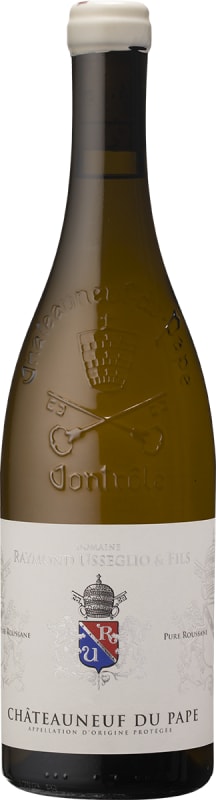


Winemaker Notes
100% Roussane made from grapes grown on sandy terroirs exposed to the north. This wine seduces with its remarkable aromatic richness and a memorable saline finish.
Professional Ratings
-
James Suckling
If you ever wondered why roussanne is something special in the Southern Rhone, here is the proof. Powerful, concentrated and full-bodied, but with terrific structure and length. Stone fruit flavors. The interaction of fine tannins and salty minerality drives the super-long finish. From a site with sandy soil and a northerly exposure. From biodynamically grown grapes with Demeter certification. Drink or hold.
-
Jeb Dunnuck
More closed aromatically, the medium gold-hued 2024 Châteauneuf Du Pape Pure Roussanne Blanc slowly offers up ripe orchard fruits, honeyed orange, crushed stone, and spice. Based on 100% Roussanne from the sandy soils of Bois Sénéchaux and aged seven months in 60% foudre and 40% new French oak, it's medium to full-bodied, has a nicely balanced, elegant mouthfeel, integrated acidity, and a great finish. It's another impeccably made, incredibly classy wine from this talented vigneron, and there are roughly 313 cases produced. Give it a year or two and drink over the following decade. Drink 2026-2035.


There are hundreds of white grape varieties grown throughout the world. Some are indigenous specialties capable of producing excellent single varietal wines. Each has its own distinct viticultural characteristics, as well as aroma and flavor profiles.

Famous for its full-bodied, seductive and spicy reds with flavor and aroma characteristics reminiscent of black cherry, baked raspberry, garrigue, olive tapenade, lavender and baking spice, Châteauneuf-du-Pape is the leading sub-appellation of the southern Rhône River Valley. Large pebbles resembling river rocks, called "galets" in French, dominate most of the terrain. The stones hold heat and reflect it back up to the low-lying gobelet-trained vines. Though the galets are typical, they are not prominent in every vineyard. Chateau Rayas is the most obvious deviation with very sandy soil.
According to law, eighteen grape varieties are allowed in Châteauneuf-du-Pape and most wines are blends of some mix of these. For reds, Grenache is the star player with Mourvedre and Syrah coming typically second. Others used include Cinsault, Counoise and occasionally Muscardin, Vaccarèse, Picquepoul Noir and Terret Noir.
Only about 6-7% of wine from Châteauneuf-du-Pape is white wine. Blends and single-varietal bottlings are typically based on the soft and floral Grenache Blanc but Clairette, Bourboulenc and Roussanne are grown with some significance.
The wine of Chateauneuf-du-Pape takes its name from the relocation of the papal court to Avignon. The lore says that after moving in 1309, Pope Clément V (after whom Chateau Pape-Clément in Pessac-Léognan is named) ordered that vines were planted. But it was actually his successor, John XXII, who established the vineyards. The name however, Chateauneuf-du-Pape, translated as "the pope's new castle," didn’t really stick until the 19th century.