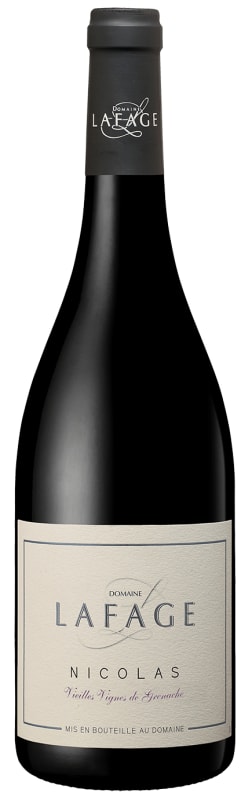


Winemaker Notes
Cuvée Nicolas is named after Jean-Marc and Eliane’s son and comes from a blend of Grenache grown in the red schist soils of the foothills of the Pyrenees in Asprès with Grenache from the back schist soils of Maury. These low yielding vines (19hl/ha) are around 65 years old and are planted on terraces with southern and southeastern exposure.
Bright ruby color. Ripe wine, loaded with red fruits on the nose. The mouth feel is concentrate, with soft tannins, and tastes of raspberry, cassis, blueberries and blackberries, with a great length.
Professional Ratings
-
Wine Enthusiast
This old-vine Grenache exhibits plenty of elegance. The nose offers anise, peppercorn, lilac and black plum aromas, all seamlessly layered. The palate is firmly built, pairing blackberry with layers of marjoram, fennel and peppercorn.
Best Buy -
James Suckling
A juicy, lively and racy old grenache with notes of cherries, red berries and grilled herbs like thyme. Medium-bodied with fine, firm tannins. Vivid fruit complemented by plenty of spices, leading to a flavorful, textured and long finish.


Grenache thrives in any warm, Mediterranean climate where ample sunlight allows its clusters to achieve full phenolic ripeness. While Grenache's birthplace is Spain (there called Garnacha), today it is more recognized as the key player in the red blends of the Southern Rhône, namely Châteauneuf-du-Pape, Côtes du Rhône and its villages. Somm Secret—The Italian island of Sardinia produces bold, rustic, single varietal Grenache (there called Cannonau). California, Washington and Australia have achieved found success with Grenache, both flying solo and in blends.

An extensive appellation producing a diverse selection of good quality and great values, Languedoc spans the Mediterranean coast from the Pyrenees mountains of Roussillon all the way to the Rhône Valley. Languedoc’s terrain is generally flat coastal plains, with a warm Mediterranean climate and frequent risk of drought.
Virtually every style of wine is made in this expansive region. Most dry wines are blends with varietal choice strongly influenced by the neighboring Rhône Valley. For reds and rosés, the primary grapes include Grenache, Syrah, Carignan, Cinsault and Mourvèdre. White varieties include Grenache Blanc, Muscat, Ugni Blanc, Vermentino, Macabéo, Clairette, Piquepoul and Bourbelenc.
International varieties are also planted in large numbers here, in particular Chardonnay, Sauvignon Blanc and Cabernet Sauvignon.
The key region for sparkling wines here is Limoux, where Blanquette de Limoux is believed to have been the first sparkling wine made in France, even before Champagne. Crémant de Limoux is produced in a more modern style.