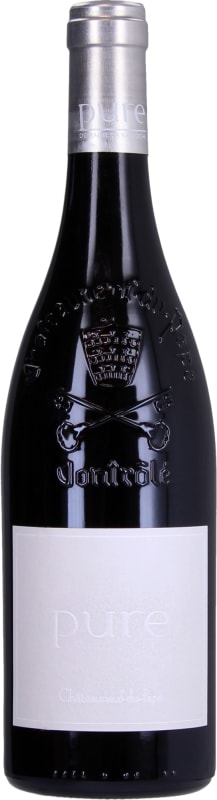


Winemaker Notes
Pure is handcrafted from a single plot of 100-year-old vines and sandy soil, at the junction of "Grand Pierre", "Rayas" and "Pointu" districts. The century-old Grenache vines are deeply rooted in this mythical plot like no other, with sandy and red Comtat sandstone soil. Not only rare and unique, the resulting wine is indescribably... pure, as well as ethereal, delicate, elegant, fresh, natural, floral, silky, unctuous and absolute.
Professional Ratings
-
Vinous
Showing the potential to be at the same level as the 2020 vintage, the 2021 Châteauneuf-du-Pape Pure is a distinctively refined version of this cuvée. Precise aromas of rose petal, blood orange, redcurrant, raspberry, strawberry, licorice, dried herbs and a pinch of white pepper waft from the glass. The velvety tannins play a crucial role in shaping a seamless mouthfeel, while the elegant finish lingers on with great persistence.
Barrel Sample: 93-95 -
Jeb Dunnuck
The 2021 Châteauneuf Du Pape Pure showed beautifully and is clearly up with the finest in the vintage. Ripe darker cherries, spring flowers, peppery garrigue, and some earthy, spicy nuances all shine, and it's medium-bodied, elegant, and seamless, with beautiful tannins. As with most of the top 2021s, it's all about finesse and elegance and is already impossible to resist. It should evolve for 10-12 years with no issues.
-
Wine Enthusiast
This wine has an innate power, yet to be unleashed. The bouquet reveals enticing notes of black plum, strawberry, black licorice, underbrush and a whisper of mint. On the palate, it remains understated for now, with juicy black cherry, olives and dried herbs subtly emerging through a delicate veil of cocoa powder, hinting at greater depth yet to be discovered. Patience is key and will unlock its true potential.
-
Wine Spectator
Offers ripeness and concentration for the lighter vintage. Starts broad and generous, then firms up quickly on the palate, with a dense core of black currant and smoke sewn up with finely structured tannins. Shows equal parts power and finesse. Drink now through 2040. 250 cases made, 40 cases imported.
-
Robert Parker's Wine Advocate
The 2021 Chateauneuf du Pape Pure—Grenache from a single parcel—boasts impressive aromatics of crushed stone, floral notes of roses and lavender and mixed berries. It's medium to full-bodied, concentrated, firm and tannic—perhaps overly so? In obvious need of cellaring, cautious buyers may wish to seek out the 2020 or hold out for the 2022, but I suspect the 2021 will come around in due time.
Rating: 92+?


Grenache thrives in any warm, Mediterranean climate where ample sunlight allows its clusters to achieve full phenolic ripeness. While Grenache's birthplace is Spain (there called Garnacha), today it is more recognized as the key player in the red blends of the Southern Rhône, namely Châteauneuf-du-Pape, Côtes du Rhône and its villages. Somm Secret—The Italian island of Sardinia produces bold, rustic, single varietal Grenache (there called Cannonau). California, Washington and Australia have achieved found success with Grenache, both flying solo and in blends.

Famous for its full-bodied, seductive and spicy reds with flavor and aroma characteristics reminiscent of black cherry, baked raspberry, garrigue, olive tapenade, lavender and baking spice, Châteauneuf-du-Pape is the leading sub-appellation of the southern Rhône River Valley. Large pebbles resembling river rocks, called "galets" in French, dominate most of the terrain. The stones hold heat and reflect it back up to the low-lying gobelet-trained vines. Though the galets are typical, they are not prominent in every vineyard. Chateau Rayas is the most obvious deviation with very sandy soil.
According to law, eighteen grape varieties are allowed in Châteauneuf-du-Pape and most wines are blends of some mix of these. For reds, Grenache is the star player with Mourvedre and Syrah coming typically second. Others used include Cinsault, Counoise and occasionally Muscardin, Vaccarèse, Picquepoul Noir and Terret Noir.
Only about 6-7% of wine from Châteauneuf-du-Pape is white wine. Blends and single-varietal bottlings are typically based on the soft and floral Grenache Blanc but Clairette, Bourboulenc and Roussanne are grown with some significance.
The wine of Chateauneuf-du-Pape takes its name from the relocation of the papal court to Avignon. The lore says that after moving in 1309, Pope Clément V (after whom Chateau Pape-Clément in Pessac-Léognan is named) ordered that vines were planted. But it was actually his successor, John XXII, who established the vineyards. The name however, Chateauneuf-du-Pape, translated as "the pope's new castle," didn’t really stick until the 19th century.