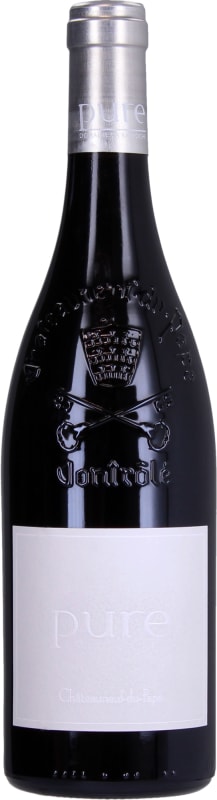


Winemaker Notes
Blend: 97% Grenache, 3% Other Varietals
Professional Ratings
-
Jeb Dunnuck
The tiny production 2020 Châteauneuf Du Pape Pure is all Grenache brought up in a single foudre. It's slightly lighter-hued than the base cuvée (which is normal) and offers a heavenly perfume of black cherries, kirsch liqueur, roasted garrigue, Asian spices, licorice, and graphite. This carries to a full-bodied Châteauneuf du Pape revealing remarkable elegance and purity, ultra-fine tannins, perfect balance, and a great, great finish. I'm not sure it has the same level of grandeur as the 2019, but it’s not far off, and time will tell. Regardless, this beauty has everything you could want in a great wine: richness, power, elegance, and complexity. It's a true “Wow” wine in every regard and will shine for 15-20 years.
-
James Suckling
Although this smells of baked black fruits, it is all the other aromas that make it so amazing: hot dry earth, grilled bread, Mediterranean herbs and a whole range of spices. Even better, it has wonderful vitality on the very concentrated palate, thanks to the beautifully crafted tannin structure. What fascinating complexity and energy at the very sensual finish. Drinkable now, but best from 2025.
-
Robert Parker's Wine Advocate
I last reviewed this wine from foudre, so here's an update now that it has been in bottle. The 2020 Chateauneuf du Pape Pure is all Grenache from a single sandy parcel at the junction of three lieux-dits (le Grand Pierre, le Pointu and le Rayas). Vinified in concrete and aged in foudre, there are initial hints of struck match and crushed stone on the nose, followed by intense blackberry and black cherry fruit and subtle nuances of garrigue and rose petals. Full-bodied, dense and velvety in feel, it finishes long, marked by pronounced acids, which should serve the wine well as it ages over the next two decades. Rating: 96+
-
Decanter
Cherry blossom, thyme, strawberry and black olive. Medium-bodied, with piercingly bright acidity. Very classic style of Châteauneuf, bright and juicy, silky and not overly full-bodied, with a little touch of sucrosité at its heart. The alcohol is high but not hot, tempered by the acidity and raw energy in the wine. 100% Grenache from a plot of 100-year-old vines planted on the sandy soils at the junction of lieux-dits Rayas, Grand Pierre and Le Pointu.
-
Vinous
Winemaker Julien Barrot is making a much more elegant rendition of single varietal Grenache Châteauneuf-du-Pape Pure, compared to the 2005 vintage of this cuvée with its otherworldly complexity and intensity. The 2020 vintage opens up with enticing aromas of crushed violets, blood orange, raspberry, forest strawberry, black cherry, dried herbs, mint and licorice. Showing absolutely no hard edges, plush tannins envelop the palate of this full-bodied red impeccably well balanced by lively acids. The taster is left with a bold finish that goes on for well over a minute. Only 4,500 bottles produced.
-
Wine Spectator
Generous and enticing, this also shows poise and great balance between generous elements of red fruit, lavender, iron-edged minerality and singed alder, which meld together on the seamless palate. This carries its weight effortlessly, with talc-fine tannins gliding through the impressively long finish.


Grenache thrives in any warm, Mediterranean climate where ample sunlight allows its clusters to achieve full phenolic ripeness. While Grenache's birthplace is Spain (there called Garnacha), today it is more recognized as the key player in the red blends of the Southern Rhône, namely Châteauneuf-du-Pape, Côtes du Rhône and its villages. Somm Secret—The Italian island of Sardinia produces bold, rustic, single varietal Grenache (there called Cannonau). California, Washington and Australia have achieved found success with Grenache, both flying solo and in blends.

Famous for its full-bodied, seductive and spicy reds with flavor and aroma characteristics reminiscent of black cherry, baked raspberry, garrigue, olive tapenade, lavender and baking spice, Châteauneuf-du-Pape is the leading sub-appellation of the southern Rhône River Valley. Large pebbles resembling river rocks, called "galets" in French, dominate most of the terrain. The stones hold heat and reflect it back up to the low-lying gobelet-trained vines. Though the galets are typical, they are not prominent in every vineyard. Chateau Rayas is the most obvious deviation with very sandy soil.
According to law, eighteen grape varieties are allowed in Châteauneuf-du-Pape and most wines are blends of some mix of these. For reds, Grenache is the star player with Mourvedre and Syrah coming typically second. Others used include Cinsault, Counoise and occasionally Muscardin, Vaccarèse, Picquepoul Noir and Terret Noir.
Only about 6-7% of wine from Châteauneuf-du-Pape is white wine. Blends and single-varietal bottlings are typically based on the soft and floral Grenache Blanc but Clairette, Bourboulenc and Roussanne are grown with some significance.
The wine of Chateauneuf-du-Pape takes its name from the relocation of the papal court to Avignon. The lore says that after moving in 1309, Pope Clément V (after whom Chateau Pape-Clément in Pessac-Léognan is named) ordered that vines were planted. But it was actually his successor, John XXII, who established the vineyards. The name however, Chateauneuf-du-Pape, translated as "the pope's new castle," didn’t really stick until the 19th century.