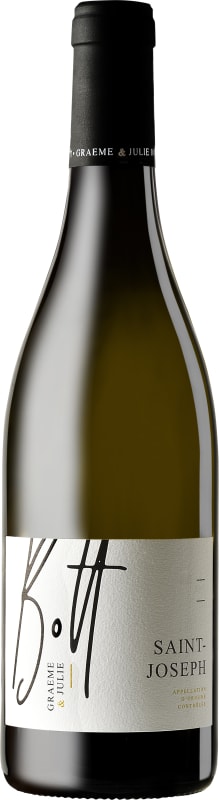


Winemaker Notes
#83 Wine Spectator Top 100 of 2021
Pale yellow with golden highlights. Intense aromas of yellow fruit and white flowers. Rich on the palate, yet with a perfect balance and a long, persistent finish. An ideal pairing with shellfish and roasted poultry. Aging potential of five to ten years.Blend: 70% Roussanne – 30% Marsanne
Professional Ratings
-
Wine Spectator
Very fresh and direct in profile, with a racy beam of starfruit, white peach and yellow apple flavors liberally laced with honeysuckle and chamomile accents. A salted butter note underscores the finish. Roussanne and Marsanne. Drink now.
-
Robert Parker's Wine Advocate
A 70-30 blend of Roussanne and Marsanne, the Botts' 2019 Saint Joseph Blanc spent nine months in oak. Ripe, honeyed notes emerge on the nose, while the full-bodied palate shows plenty of pear and melon fruit but also complementary notions of structure and length, with a long, stony finish.


Full-bodied and flavorful, white Rhône blends originate from France’s Rhône Valley. Today these blends are also becoming popular in other regions. Typically some combination of Grenache Blanc, Marsanne, Roussanne and Viognier form the basis of a white Rhône blend with varying degrees of flexibility depending on the exact appellation. Somm Secret—In the Northern Rhône, blends of Marsanne and Roussanne are common but the south retains more variety. Marsanne, Roussanne as well as Bourboulenc, Clairette, Picpoul and Ugni Blanc are typical.

Spanning the longest stretch of river in the northern Rhône—from Condrieu in the north, to Cornas in the south—the heart of St.-Joseph lies directly across the Rhône River from Hermitage. While its soils are basically the same as Hermitage: granite, supplemented by sand and gravel, its east facing slope receives less sunlight than Hermitage, which causes less overall berry ripening on its Syrah vines. However, some of the best of them can rival any fine expression of Hermitage, Cote-Rotie or Cornas with concentrated black fruits, dark spices, crushed rock and violets. A general advantage of the region is that its Syrahs typically don’t need as much time in the bottle compared to a Cote-Rotie or Hermitage and are much easier on the bank account!
A textbook St.-Joseph red is firm with a core of minerality that is enhanced by savory and peppery qualities. Aromas and flavors of smoke, olives, herbs, and violets are common; its wines are dense in red and black fruit.
St.-Joseph is also a source of fine northern Rhône white wine. Viognier, Marsanne and Roussanne grow well here and can be blended or made into single varietal wines. St.-Joseph whites are full and silky with citrus, pear and pineapple flavors and a rich bouquet reminiscent of honeysuckle, toasted nuts, spice and caramel.