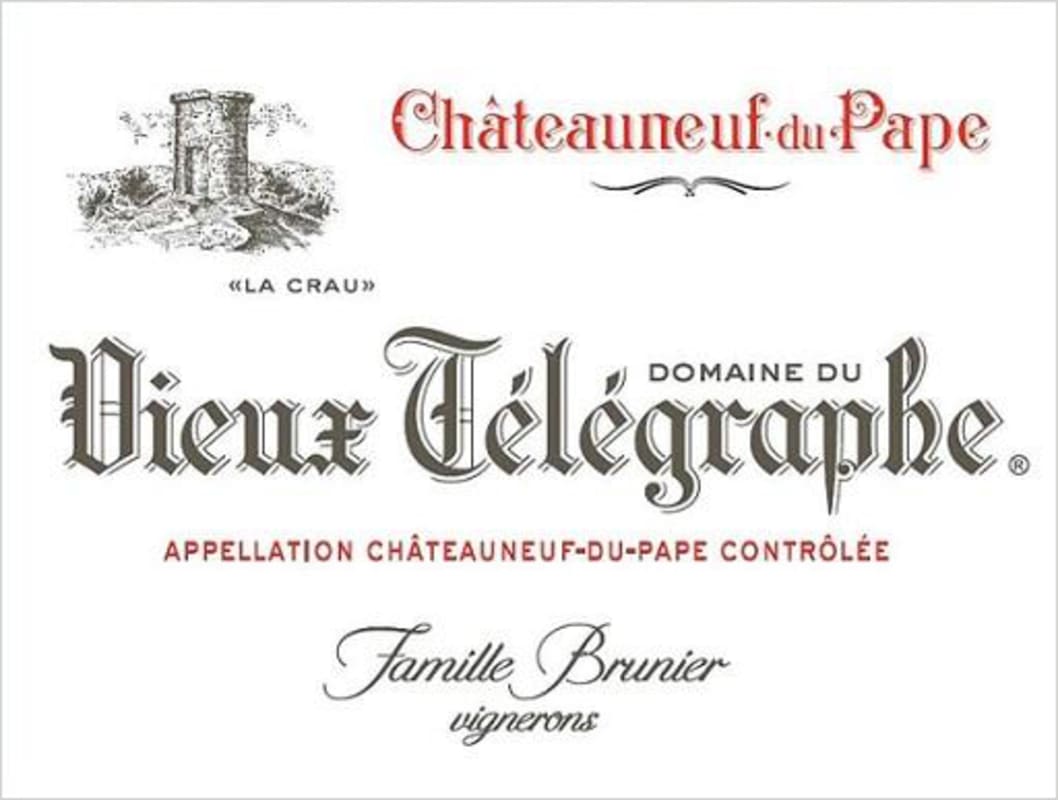

Winemaker Notes
#7 Wine Spectator Top 100 of 2024
The 2020 Domaine du Vieux Telegraphe Chateauneuf-du-Pape La Crau is a classic red Châteauneuf-du-Pape, very fine and elegant. The best vintages will age for 25 years and more.
Blend: 60% Grenache, 20% Mourvèdre, 15% Syrah, 5% Other Varieties
Professional Ratings
-
James Suckling
This amazing Chateauneuf-du-Pape squares the circle of southern richness and spring-like freshness in spite of coming from a very warm and dry vintage. The stony minerality, saltiness and dried flower character wind together to form a dynamic whole, driving this gracefully across the palate. But I must also mention the savory and licorice richness that is so deftly wrapped around them. Very long, salty and velvety finish.
-
Decanter
Full, generous and broad. Acids are bright and vibrant, and there's a fine but dense weft of tannins through the wine. Great energy and salinity this year, this is particularly fine and balanced, with plenty of concentration and a long finish. All from La Crau and fermented in tronconic wood barrels. Élevage in foudre. Oldest Grenache bunches aren't destemmed.
-
Robert Parker's Wine Advocate
Marked by ripe cherries and hints of complex garrigue notes on the nose, it's full-bodied but also really elegant, with fine-grained, silky tannins, ample concentration and a long, surprisingly crisp finish.
Barrel Sample: 93-95 -
Jeb Dunnuck
The 2020 Châteauneuf Du Pape also showed well, with a lighter, elegant style that still brings plenty of intensity. Black cherries, mulberries, dried violets, and loamy earth define the bouquet, and it's medium-bodied, balanced, and finesse-driven on the palate, with ripe tannins as well as a terrific sense of salinity on the finish. Give bottles 3-4 years and enjoy over the following 15+.
-
Vinous
The 2020 Châteauneuf-du-Pape La Crau was vinified from partially de-stemmed grapes and aged in foudre. The 2020 La Crau displays pronounced aromas of rose petals, redcurrant, red and black cherry, raspberry, strawberry and hints of smoke. Full-bodied, refined and built like a brick wall, it will reward bottle age.
-
Wine Spectator
This shows a lot of aromatic appeal, with dusty earth and singed incense notes covering a well of fresh cherry and red currant flavors. A gutsy, grippy style on the palate, with a cast iron spine bringing firm shape and underlying power. Slightly old-school, this still needs time to unfurl. Grenache, Mourvedre, Syrah and Cinsault. Best from 2025 through 2035.


With bold fruit flavors and accents of sweet spice, Grenache, Syrah and Mourvèdre form the base of the classic Rhône Red Blend, while Carignan, Cinsault and Counoise often come in to play. Though they originated from France’s southern Rhône Valley, with some creative interpretation, Rhône blends have also become popular in other countries. Somm Secret—Putting their own local spin on the Rhône Red Blend, those from Priorat often include Merlot and Cabernet Sauvignon. In California, it is not uncommon to see Petite Sirah make an appearance.

Famous for its full-bodied, seductive and spicy reds with flavor and aroma characteristics reminiscent of black cherry, baked raspberry, garrigue, olive tapenade, lavender and baking spice, Châteauneuf-du-Pape is the leading sub-appellation of the southern Rhône River Valley. Large pebbles resembling river rocks, called "galets" in French, dominate most of the terrain. The stones hold heat and reflect it back up to the low-lying gobelet-trained vines. Though the galets are typical, they are not prominent in every vineyard. Chateau Rayas is the most obvious deviation with very sandy soil.
According to law, eighteen grape varieties are allowed in Châteauneuf-du-Pape and most wines are blends of some mix of these. For reds, Grenache is the star player with Mourvedre and Syrah coming typically second. Others used include Cinsault, Counoise and occasionally Muscardin, Vaccarèse, Picquepoul Noir and Terret Noir.
Only about 6-7% of wine from Châteauneuf-du-Pape is white wine. Blends and single-varietal bottlings are typically based on the soft and floral Grenache Blanc but Clairette, Bourboulenc and Roussanne are grown with some significance.
The wine of Chateauneuf-du-Pape takes its name from the relocation of the papal court to Avignon. The lore says that after moving in 1309, Pope Clément V (after whom Chateau Pape-Clément in Pessac-Léognan is named) ordered that vines were planted. But it was actually his successor, John XXII, who established the vineyards. The name however, Chateauneuf-du-Pape, translated as "the pope's new castle," didn’t really stick until the 19th century.