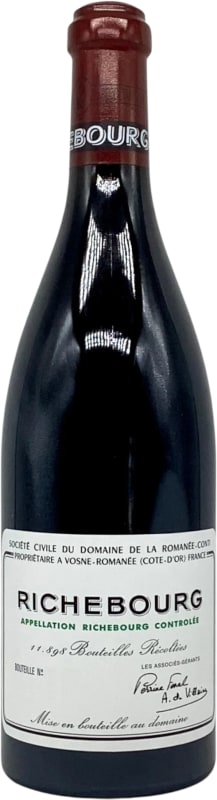


Winemaker Notes
Professional Ratings
-
Decanter
The colour is as deep as the Romanée-Saint-Vivant, but the Richebourg is an entirely different wine, less forward and more substantial. It seems somewhat reserved, but as it opens, there are impressive layers of flavour, from a ripe black cherry fruit to a sweet floral note and hints of graphite and menthol that are very attractive. Although the Romanée-Saint-Vivant is more forward, the Richebourg has more cellar potential - it's difficult not to bump this up a notch upon review. This wine should start to open properly after ten years in bottle. Picked 29 September – 1 October; 4,262 bottles produced.
-
Jasper Morris
Barely deeper than the Romanée St-Vivant in colour, though the depth of fruit on the nose certainly takes us further. Here the fruit overwhelms the whole bunch aspect. Well, you can still see both but the fruit insists. A bevy of red berries, which have just achieved the right level of whiteness, white pepper livening up the whole, but the whole comes across as seamless and close to being sensual. There is an underlying intricacy to the fruit which stops the weight becoming monolithic. This will be an exceptional bottle. The harmony is absolute.
-
Robert Parker's Wine Advocate
The 2021 Richebourg Grand Cru derives entirely from lieu-dit Les Richebourg, as the domaine's holdings in Les Verroilles ou Richebourg are being replanted, though quite whether that has subtly altered the style of the bottling is hard to say with just one vintage in bottle. It's both fuller and primer than the Saint-Vivant this year, exhibiting dark cherry and framboise fruit tones mingled with notions of peony, candied peel and spruce bough. Full-bodied, sumptuous and satiny, with a textural attack that segues into a richly paltered core of fruit, its plenitude is as impressive as its long, sapid finish.


Thin-skinned, finicky and temperamental, Pinot Noir is also one of the most rewarding grapes to grow and remains a labor of love for some of the greatest vignerons in Burgundy. Fairly adaptable but highly reflective of the environment in which it is grown, Pinot Noir prefers a cool climate and requires low yields to achieve high quality. Outside of France, outstanding examples come from in Oregon, California and throughout specific locations in wine-producing world. Somm Secret—André Tchelistcheff, California’s most influential post-Prohibition winemaker decidedly stayed away from the grape, claiming “God made Cabernet. The Devil made Pinot Noir.”

This is the village for the most die-hard Burgundy fanatics. Vosne-Romanée has for many hundreds of years been the source of the most sought-after Pinot Noir in Burgundy. The village claims six Grands Crus—and some of the most famous at that—but in other villages where owners manage tiny parcels or a few rows of any one vineyard, monopolies dominate the Grands Crus of Vosne-Romanee.
Of these monopolies, Domaine Romanee-Conti (DRC) reigns supreme, claiming not only more total vineyard area than any other producer, but outright owning the entirety of two of the Grands Crus and a majority of two others. In its full possession are naturally Romanée-Conti, as well as La Tâche. DRC also owns most of Richebourg and Romanée-St-Vivant. The final two, La Grande Rue and La Romanée are completely owned by other other produers: François Lamarche and Comte Liger Belair, respectively.
While one could spend a lifetime on the puzzles of land ownership in Burgundy, the point is that Vosne-Romanee contains the most valuable pieces of vineyard real estate in the world. Pinot Noir from any of its vineyards—especially from within its 27ha of Grand Cru or 58 ha of Premier Cru land—is going to rank among the best.
The most outstanding wines from this village have everything: finesse and elegance coupled with the body and sturdiness for incredibly long aging ability. They are intensely floral and exotically spiced. Beautifully ripe, complex and ephemeral throughout, they are robust, yet fine-grained in texture. These wines will stay gorgeous for the long haul.