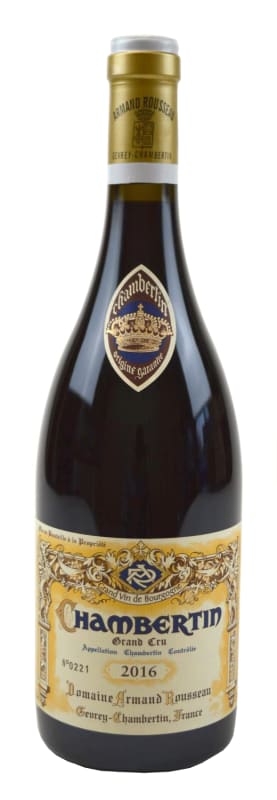


Winemaker Notes
Professional Ratings
-
Wine Spectator
This majestic red offers a beam of succulent, pure cherry, oak spice, sandalwood and cinnamon notes. Intensely flavored, with a distinctive creaminess and harmony. Expands on the finish, where all the components come together, tying this up neatly on the lingering spice- and mineral-infused aftertaste. Best from 2024 through 2048.
-
Robert Parker's Wine Advocate
Tasted from bottle, the 2016 Chambertin Grand Cru claims the place of king of the Rousseau cellar this year, soaring from the glass with a complex bouquet of ripe red berries, cherries and plums, complemented by nuances of blood orange, peonies, raw cocoa, grilled meats and spices. On the palate, the wine is full-bodied, deep and multidimensional, with terrific concentration, lively acids and a muscular chassis of ripe tannins that's largely concealed by a prodigious core of fruit. Long, sapid and penetrating, like the Clos de Bèze, this will make for fascinating comparisons with its 2015 counterpart in two decades' time.
-
James Suckling
Expansive nose of black cherry and red fruit with plenty of toasty oak. Bold and generous palate for a Grand Cru from the 2016 vintage. Keeps pumping out the red fruit at the elegant and slightly toasty finish. Drink or hold.


Thin-skinned, finicky and temperamental, Pinot Noir is also one of the most rewarding grapes to grow and remains a labor of love for some of the greatest vignerons in Burgundy. Fairly adaptable but highly reflective of the environment in which it is grown, Pinot Noir prefers a cool climate and requires low yields to achieve high quality. Outside of France, outstanding examples come from in Oregon, California and throughout specific locations in wine-producing world. Somm Secret—André Tchelistcheff, California’s most influential post-Prohibition winemaker decidedly stayed away from the grape, claiming “God made Cabernet. The Devil made Pinot Noir.”

This small village is home to the Grands Crus in the farthest northerly stretches of Côte de Nuits and is famous for some of the deepest and firmest Burgundian Pinot Noir.
Gevrey boasts nine Grands Crus, the best of which are arguably Le Chambertin and Chambertin-Clos de Bèze. As with all of the fragmented vineyards of Burgundy, it isn’t easy to differentiate between the two, which are situated adjacent with Clos de Bèze slightly further up the hill than Le Chambertin. Clos de Bèze has a shallower soil and if you’re really counting, may produce wines less intense but more likely to charm. Some compare Le Chambertin in both power and plentitude only to the prized Romanée-Conti Grand Cru farther south in Vosne-Romanée.
Two other Grands Crus vineyards, Mazis-Chambertin (also written Mazy-) and Latricières-Chambertin command almost as much regard as Le Chambertin and Chambertin-Clos de Bèze. The upper part of Mazy, called Les Mazis Haut is the best and Latricières-Chambertin offers an abundance of juicy fruit and a silky texture in the warmer vintages.
Other Grands Crus are Ruchottes-Chambertin, Charmes-Chambertin, Mazoyères-Chambertin, Griotte-Chambertin and Chapelle-Chambertin.
The most respected Pinot Noir wines from Gevrey-Chambertin are robust and powerful but at the same time, velvety and expressive: black fruit, black liquorice and chocolate come into play. After some time in the bottle, the wines are harmonious with bright and sometimes candied fruit, and aromas of musk, truffle and forest floor. These have staying power.