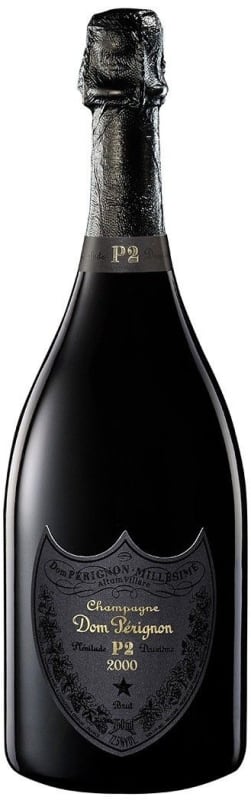


Winemaker Notes
The vibrant opening strikes the first chord, a prelude to a complexity that is more tactile than plump and only gives of itself gradually. The distinguished viscosity is understated and simply fits around the contours of the wine. The length is exquisitely bitter and abounds with sap, a mingling of liquorice and toasted malt.
Coherence is the key characteristic of P2 2000. To reveal it and to make the wine react through pairings, the provocation is the way with a strong beef stock or ravioli of whelks in parsley. It’s Interesting to draw it out through small touches within rich, complete meals: fried artichokes, sea bass, peach salad and Kombu; grilled potato chips, milk foam, and caviar. Piece by piece, a pointillist menu is assembled around the sensations of the Dom Pérignon P2 2000.
Professional Ratings
-
James Suckling
A Champagne that has turned to a very fine texture with dried pineapple and lemon character. Medium to full body, complex and flavorful palate. Shows length and beauty. Pie crust, cooked apple and lemon rind continue on the finish. A truly great 2000 with a combination of finesse and strength. It’s very, very minerally to a point of sea salt. It was disgorged in first half of 2016.
-
Wine Spectator
A beautiful nose of baked peach, lime blossom and graphite draws you into the glass of this stunning 2000, whose flavors of brioche, salted almond and spun honey are wrapped around sleek, mouthwatering acidity and a streak of smoke-tinged mineral. This deftly meshed Champagne is hard to stop sipping. Drink now through 2030.
-
Robert Parker's Wine Advocate
The 2000 Dom Pérignon P2 opens in the glass with aromas of waxy citrus oil, warm bread, dried fruits, fresh peach and iodine. On the palate, it's medium to full-bodied, satiny and textural, with a sweet core of mature fruit, ripe acids and a sapid, elegantly toasty finish. As I wrote earlier this year, the 2000 vintage delivered a precocious Dom Pérignon, and this recently disgorged rendition has really benefited from the additional time sur lattes, acquiring notably more complexity—while retaining more energy—than the original disgorgement.



Dom Pérignon: an absolute commitment to Vintage
Dom Pérignon's commitment to vintage is absolute. Each Dom Pérignon is a true act of creation, made from only the best grapes. The champagne's intensity is based in precision, so inviting, so mysterious. Each Vintage has three Plénitudes, and embodies the total faith in the creation that is constantly renewed by Chef de Cave Vincent Chaperon. Coupled with a bold sense of playfulness, Dom Pérignon inspires the greatest creators in the world.Made only from the best grapes grown in one single year, each Dom Perignon's Vintage represents a harmonic balance between the nature of the year and the signature of Dom Pérignon. After no fewer than 8 years of elaboration, each vintage emerges complete, seamless and tactile. Dom Pérignon Champagne is made through an assemblage of Pinot Noir and Chardonnay, created by using only the best grapes harvested from the 17 Grands Crus in Champagne and the Premier Cru of Hautvillers.

Representing the topmost expression of a Champagne house, a vintage Champagne is one made from the produce of a single, superior harvest year. Vintage Champagnes account for a mere 5% of total Champagne production and are produced about three times in a decade. Champagne is typically made as a blend of multiple years in order to preserve the house style; these will have non-vintage, or simply, NV on the label. The term, "vintage," as it applies to all wine, simply means a single harvest year.

Associated with luxury, celebration, and romance, the region, Champagne, is home to the world’s most prized sparkling wine. In order to bear the label, ‘Champagne’, a sparkling wine must originate from this northeastern region of France—called Champagne—and adhere to strict quality standards. Made up of the three towns Reims, Épernay, and Aÿ, it was here that the traditional method of sparkling wine production was both invented and perfected, birthing a winemaking technique as well as a flavor profile that is now emulated worldwide.
Well-drained, limestone and chalky soil defines much of the region, which lend a mineral component to its wines. Champagne’s cold, continental climate promotes ample acidity in its grapes but weather differences from year to year can create significant variation between vintages. While vintage Champagnes are produced in exceptional years, non-vintage cuvées are produced annually from a blend of several years in order to produce Champagnes that maintain a consistent house style.
With nearly negligible exceptions, . These can be blended together or bottled as individual varietal Champagnes, depending on the final style of wine desired. Chardonnay, the only white variety, contributes freshness, elegance, lively acidity and notes of citrus, orchard fruit and white flowers. Pinot Noir and its relative Pinot Meunier, provide the backbone to many blends, adding structure, body and supple red fruit flavors. Wines with a large proportion of Pinot Meunier will be ready to drink earlier, while Pinot Noir contributes to longevity. Whether it is white or rosé, most Champagne is made from a blend of red and white grapes—and uniquely, rosé is often produce by blending together red and white wine. A Champagne made exclusively from Chardonnay will be labeled as ‘blanc de blancs,’ while ones comprised of only red grapes are called ‘blanc de noirs.’