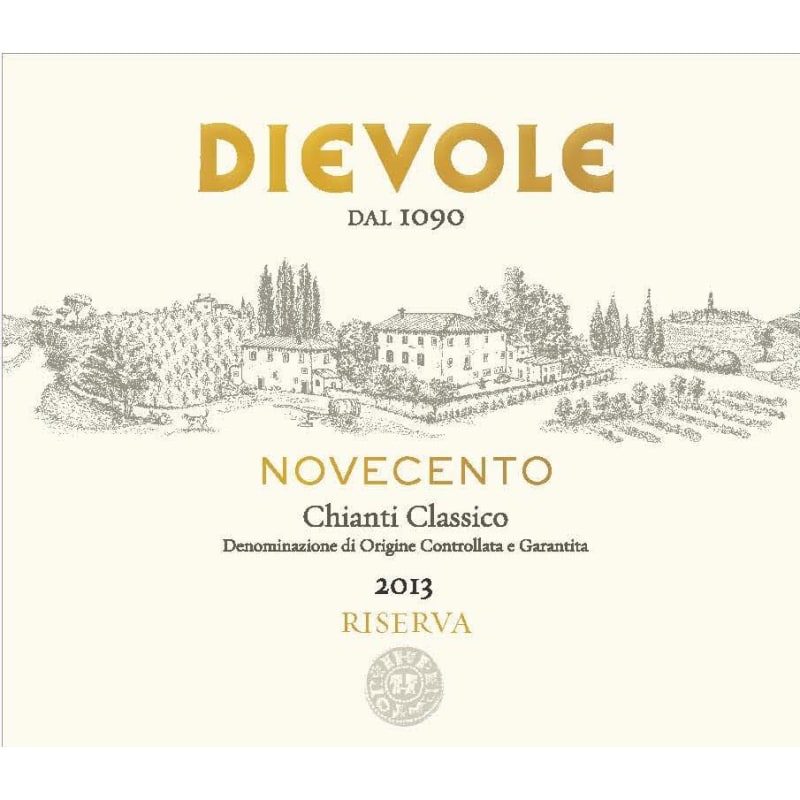

Winemaker Notes
Professional Ratings
-
Robert Parker's Wine Advocate
This wine will be released in April 2016. The 2013 Chianti Classico Riserva Novecento was recently bottled when I tasted it. Despite this vulnerable time in its evolution, the wine shows a high tenor of focus, vitality, energy and power. This momentum appears solely driven by the quality of the 2013 fruit and the hands-off wine philosophy that is being implemented under the new Dievole ownership. No enological products are used to speed up the fermentation process and wood vessels are being replaced by cement vats with inside cooling systems. Great attention is paid to vineyard management and harvest dates for optimal ripening. The wine needs to flesh out further, but it promises a very satisfying performance once it does.


Among Italy's elite red grape varieties, Sangiovese has the perfect intersection of bright red fruit and savory earthiness and is responsible for the best red wines of Tuscany. While it is best known as the chief component of Chianti, it is also the main grape in Vino Nobile di Montepulciano and reaches the height of its power and intensity in the complex, long-lived Brunello di Montalcino. Somm Secret—Sangiovese doubles under the alias, Nielluccio, on the French island of Corsica where it produces distinctly floral and refreshing reds and rosés.

One of the first wine regions anywhere to be officially recognized and delimited, Chianti Classico is today what was originally defined simply as Chianti. Already identified by the early 18th century as a superior zone, the official name of Chianti was proclaimed upon the area surrounding the townships of Castellina, Radda and Gaiole, just north of Siena, by Cosimo III, Grand Duke of Tuscany in an official decree in 1716.
However, by the 1930s the Italian government had appended this historic zone with additonal land in order to capitalize on the Chianti name. It wasn’t until 1996 that Chianti Classico became autonomous once again when the government granted a separate DOCG (Denominazione di Origine Controllata e Garantita) to its borders. Ever since, Chianti Classico considers itself no longer a subzone of Chianti.
Many Classicos are today made of 100% Sangiovese but can include up to 20% of other approved varieties grown within the Classico borders. The best Classicos will have a bright acidity, supple tannins and be full-bodied with plenty of ripe fruit (plums, black cherry, blackberry). Also common among the best Classicos are expressive notes of cedar, dried herbs, fennel, balsamic or tobacco.