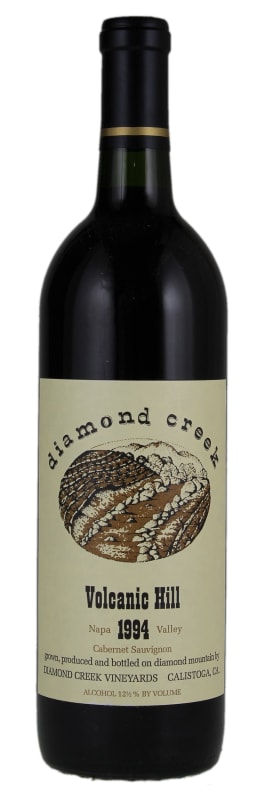


Winemaker Notes
Professional Ratings
-
Robert Parker's Wine Advocate
All three 1994s are backward, well-built, tannic wines meant to last for two decades or more. I suspect they will be among the least flattering wines to taste when released. The most impressively-endowed wine of the three is the 1994 Volcanic Hill Cabernet Sauvignon. The color is opaque purple. The wine offers a glorious display of blackcurrant, plum, and blueberry fruit gently infused with toasty oak. The roasted, smoky, richness of this wine is immediately apparent when it hits the palate. There are layers of ripe, unctuously-textured fruit, full body, and hard hitting tannin in the finish. It is backward, rich, and extremely impressive. As a fan of Diamond Creek Cabernet Sauvignons in the seventies and early eighties, I have frequently detailed my lack of enthusiasm for vintages after 1984. For that reason, I am happy to report that barrel samples of Diamond Creek's 1994s look to be the most reassuringly fine examples of this estate's Cabernets that I have tasted since 1984. Let's hope they put the wines into the bottle naturally, without excessive fining or filtering. Certainly the raw materials are very impressive. Range: 92-95
-
Wine Spectator
Tight, complex and backward, with grape, currant and berry-laced flavors, and firm tannins on the finish. Hold off for now.


One of the most prestigious wines of the world capable of great power and grace, Napa Valley Cabernet is a leading force in the world of fine, famous, collectible red wine. Today the Napa Valley and Cabernet Sauvignon are so intrinsically linked that it is difficult to discuss one without the other. But it wasn’t until the 1970s that this marriage came to light; sudden international recognition rained upon Napa with the victory of the Stag’s Leap Wine Cellars 1973 Cabernet Sauvignon in the 1976 Judgement of Paris.
Cabernet Sauvignon undoubtedly dominates Napa Valley today, covering half of the land under vine, commanding the highest prices per ton and earning the most critical acclaim. Cabernet Sauvignon’s structure, acidity, capacity to thrive in multiple environs and ability to express nuances of vintage make it perfect for Napa Valley where incredible soil and geographical diversity are found and the climate is perfect for grape growing. Within the Napa Valley lie many smaller sub-AVAs that express specific characteristics based on situation, slope and soil—as a perfect example, Rutherford’s famous dust or Stags Leap District's tart cherry flavors.